New York City--N.Y. Daily News--July 9-14, 1947
Major daily NY newspaper makes multiple attempts and gives much column and photo coverage to radar target launches to test theory they account for flying saucers. Brooklyn radar target manufacturer gets them going.
N.Y. Daily News, Wed, JULY 9, 1947, p. 3
Novelty Maker Tags Discs As Weather Balloon Parts
by Art Noble
A paper novelty firm executive stepped up last night with what he thinks is the answer to the riddle stumping all America—the riddle of the flying saucers.
He is convinced that the saucers are pilot balloon targets used by the Army Signal Corps and Air Forces during the war for weather observations, and now widely used by weather observers.
He estimated that more than a half million of these targets were manufactured by his and other firms, and thinks that a great number of them have been put into use by weather bureaus and college observatories since the war.
He offered his solution just about the time a Fort Worth Army Airfield weather officer yesterday identified a so-called flying disc found last week by a Roswell, N. M., rancher, as a part of a weather balloon.
Paper, Foil and Balsa.
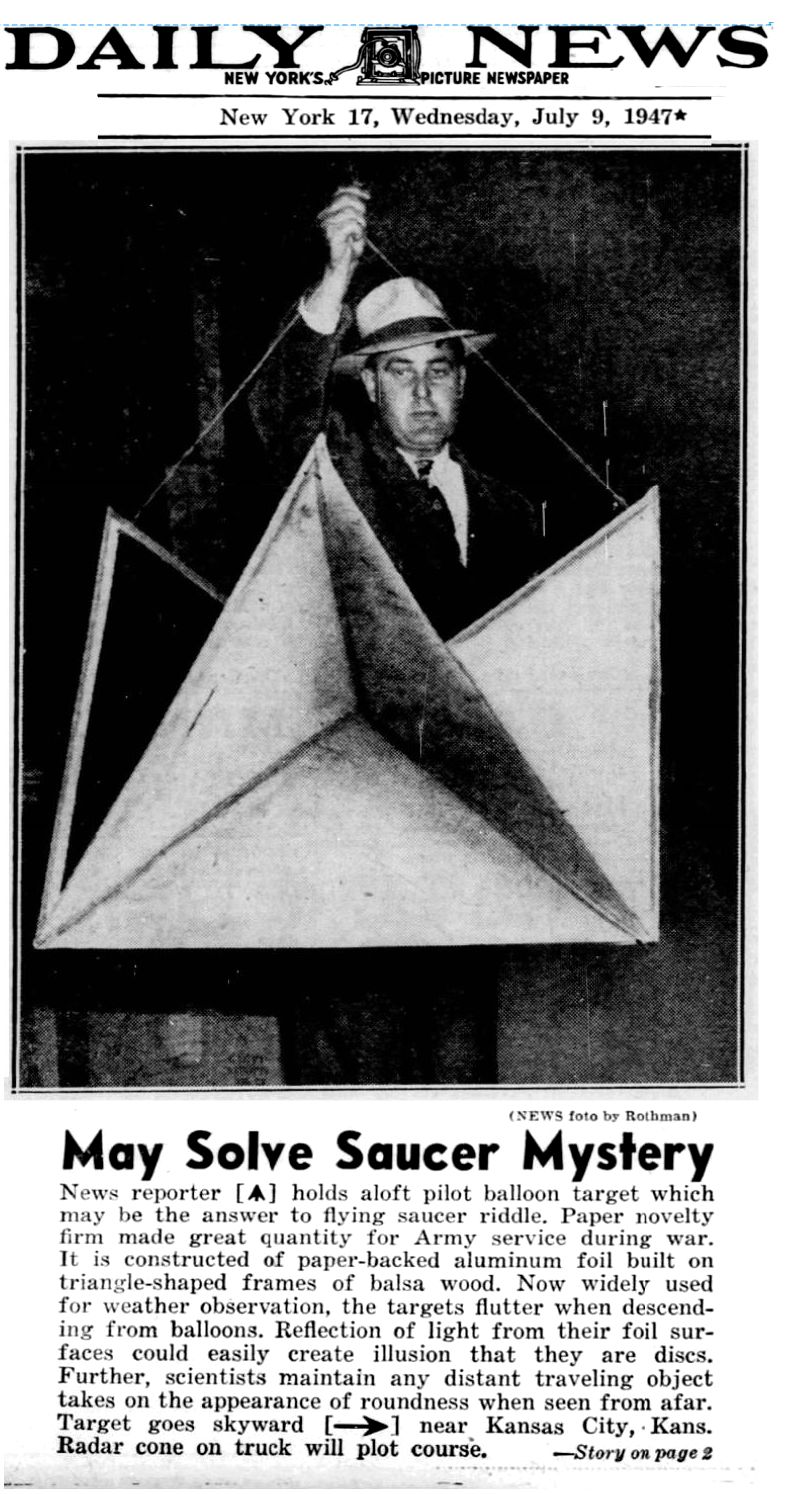
The pilot balloon target is made of a group of triangles of paper-backed aluminum foil built on strips of balsa wood, and forming four triangular pyramids. It is designed so as to rise in the air with the least possible resistance and present its aluminum foil surfaces at known angles for the reflection of radar beams.
The riddle-solver has the theory that the reflection of the sun on these foil surfaces as they revolved would create the illusion to the ordinary observer of whirling saucers traveling at great speed.
40 Inches Long.
For weather observations the targets are suspended from free hydrogen balloons and present a peculiar many-pointed appearance. They are 40 inches long, measured from extreme to extreme, and weigh 11 ounces.
The balloons are colorless and therefore, according to the manufacturer, invisible. For this reason he believes that observers of the flying saucers saw only the targets suspended below the balloons.
When a target breaks free of the balloon and starts to descend, the manufacturer said, it actually flutters like a leaf. But the speed of light and the reflection of it from the foil surfaces, he believes, create the illusion that has had the
(Continued on page 45, col. 1)
Novelty Man Tags Discs As Targets on Balloons
(Continued from page 2)
whole country on practically a witch hunt.
Howard Blakeslee, Associated Press science editor, has explained that at great distances all objects appear round or nearly so to the human eye.
The News informant agrees with Blakeslee and is sure that the balloon targets, with their many points, have been sighted at great distances, and for that reason have registered as round.
Developed at Harvard.
The manufacturer revealed that Harvard scientists developed these balloon targets, and that this is the second type designed. The first, with the same principle of triangular pyramids, but with a flat top, was used in the invasion of Normandy on June 6, 1944. These devices were instrumental, he said, in forecasting a 12-hour break in the weather that enabled the Allies to carry out their landing plans.
The type was discarded, however, because the flat top created air resistance that hampered the instrument in rising. Experiments at Harvard and by the Army Signal Corps at Eatontown, N. J., resulted in the development of the present type in late 1944. Its military designation is Pilot Balloon Target ML-307 AF.
CAPTION:
(NEWS foto by Rothman)
May Solve Saucer Mystery
News reporter [▲] holds aloft pilot balloon target which may be the answer to flying saucer riddle. Paper novelty firm made great quantity for Army service during war. It is constructed of paper-backed aluminum foil built on triangle-shaped frames of balsa wood. Now widely used for weather observation, the targets flutter when descending from balloons. Reflection of light from their foil surfaces could easily create illusion that they are discs. Further, scientists maintain any distant traveling object takes on the appearance of roundness when seen from afar. Target goes skyward [→] near Kansas City, Kans. Radar cone on truck will plot course. —Story on page 2 [Clink on link to see photo of Kansas City radar target demo]
Army Weather Men
Doubt Target Theory
Washington, D. C., July 8 (P). Army weather experts discounted tonight any idea that weather targets might be the basis for the scores of reports of flying saucers.
Brig. Gen. Donald N. Yates, chief of the AAF weather service, said only a few of them are used daily, at points where some specific project requires highly accurate wind information from extreme altitudes.
For ordinary purposes, the general said, the AAF uses balloon-borne radio sondes much on the order of those employed by the Weather Bureau. The instruments consist of a milky-white balloon five or six feet in diameter with the radio transmitting apparatus suspended below.
Between the Army and the Weather Bureau, hundreds of weather balloons are released daily all over the country.
The Weather Bureau pointed out, however, that such balloons have been in use for many years and were unlikely to be mistaken "all over the country and all in one week" for mysterious objects speeding through the sky at supersonic speeds.
N.Y. Daily Sunday News, July 13, 1947, p. 3 (separate edition)
Eyes Up for 'Saucers' Tomorrow
By ART NOBLE
New York will see its first flying saucers between noon and 1 P. M. tomorrow—we hope.
In the opinion of our flying-saucers expert, the spinning discs are probably pilot balloon targets attached to helium-inflated rubber bags. These are gadgets which weather observers send up to see which way the wind is blowing and let drift away.
Depends on Weather.
Weather permitting, several of the pilot balloon targets will be released from the News roof at noon tomorrow—and New York, which almost alone has never seen a flying saucer will see crockery in the sky. If the weather is bad, the test will be made between noon and 1 P. M. on the first clear day.
While some experts are still partial to the men-from-Mars theory, Victor Hoeflich, president of the Merri-Lei Corp., 918 Halsey St., Brooklyn, has one of the most plausible explanations of the two-week-old mystery. Hoeflich, whose firm made hundreds of thousands of pilot balloon targets during the war, reports they'd act and look just like flying saucers.
The pilot balloon target consists of a group of triangles of paper-backed aluminum foil, built on strips of balsa wood to form four three-sided pyramids. Offhand, they look just like pilot balloon targets to a meteorologist, but Hoeflich says they might give a layman a bad turn if he caught one out of the corner of his eye.
According to Hoeflich's theory, the sun is reflected from the revolving foil surfaces, causing the illusion of whirling saucers. As the flying-saucer theories have been going, this seems better than average, and The News will give it a test.
At the height of the flying-saucer furor, The News intended to start this test last Wednesday [July 9], but postponed it because of low clouds and poor visibility.
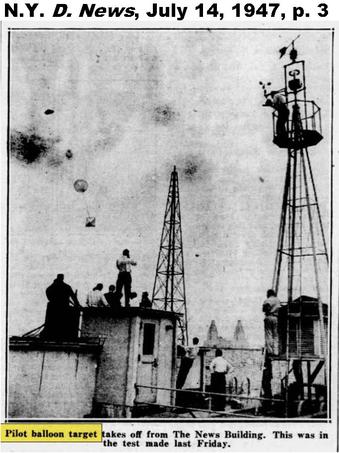
On Friday [July 11], as a sort of pre-test of the test, a balloon was released from The News roof, and in three minutes disappeared into the low clouds.
Test Brings Calls.
But in that brief time, dozens of persons in the Chrysler and Graybar Buildings spotted it and wanted to sell us the story. Though the thing seemed to be headed toward Westchester, News meteorologist J. Henry Weber said it would probably land
(Continued on page 46, col. 5)
Eyes Up; See Flying Saucer
(Continued from page 3)
in the Atlantic, giving us the honor of launching the first sea-going flying saucer.
If the saucers, such as they are, fly tomorrow as scheduled, you'll have plenty of time to work up a crick in the neck. According to Weber, the targets are visible on a clear day up to a height of three or four miles. Ascending at the rate of 400 feet a minute, they take 25 minutes to rise two miles.
There's no use trying to spot a balloon target above 50,000 feet, no matter how good your eyes or imagination. At that height the helium-filled bags blow up.
[Photo caption below (with July 14 story below): Pilot balloon target takes off from The News Building. This was in the test made last Friday.]
N.Y. Daily Sunday News, July 13, 1947 p. 3
Unmasking the Saucer—Maybe
By ART NOBLE
Keep your eyes on the skies during the 12-to-1 lunch hour tomorrow, folks. It will be worth a crick in the neck.
At that time, weather permitting, The News is going to put to the test one of the suggested answers to the riddle of the flying saucers that have kept the nation in a state since they were first reported sighted on June 24. If not tomorrow, the test will be made on the first clear day during the noon hour.
Several pilot balloon targets, attached to helium-inflated rubber bags, will be released from the roof of The News building. These contraptions may or may not be the answer to the mystery of the flying saucers.
Sun-on-Foil Theory.
Victor Hoeflich, president of the Merri-Lei Corp., of 918 Halsey St., Brooklyn, paper novelty manufacturers and makers of these flying gadgets during the war, believes they are.
The pilot balloon target is made of a group of triangles of paper-backed aluminum foil built on strips of balsa wood and forming four three-sided pyramids.
Hoeflich's theory is that the reflection of the sun on these foil surfaces as they revolve creates the illusion of whirling saucers traveling at great speed. Scientists bear him out to some extent with the added fact that objects seen at great heights and distances appear round or nearly so.
Remnants of one of these weather observation gadgets were found in Roswell, N. M., last week just after a flying saucer had been reported seen in that area. It was identified by Army airfield officers as a weather balloon target.
With all sorts of answers to the celestial discs being offered, from mass hysteria to spots before the eyes and dust on the windows, The News decided to try to solve the mystery.
Weather Delays Tests.
At the height of the flying saucer furore, The News was prepared to start these tests last Wednesday, but because of low clouds and poor visibility which continued the rest of the week, had to postpone them until tomorrow, or the first clear day thereafter.
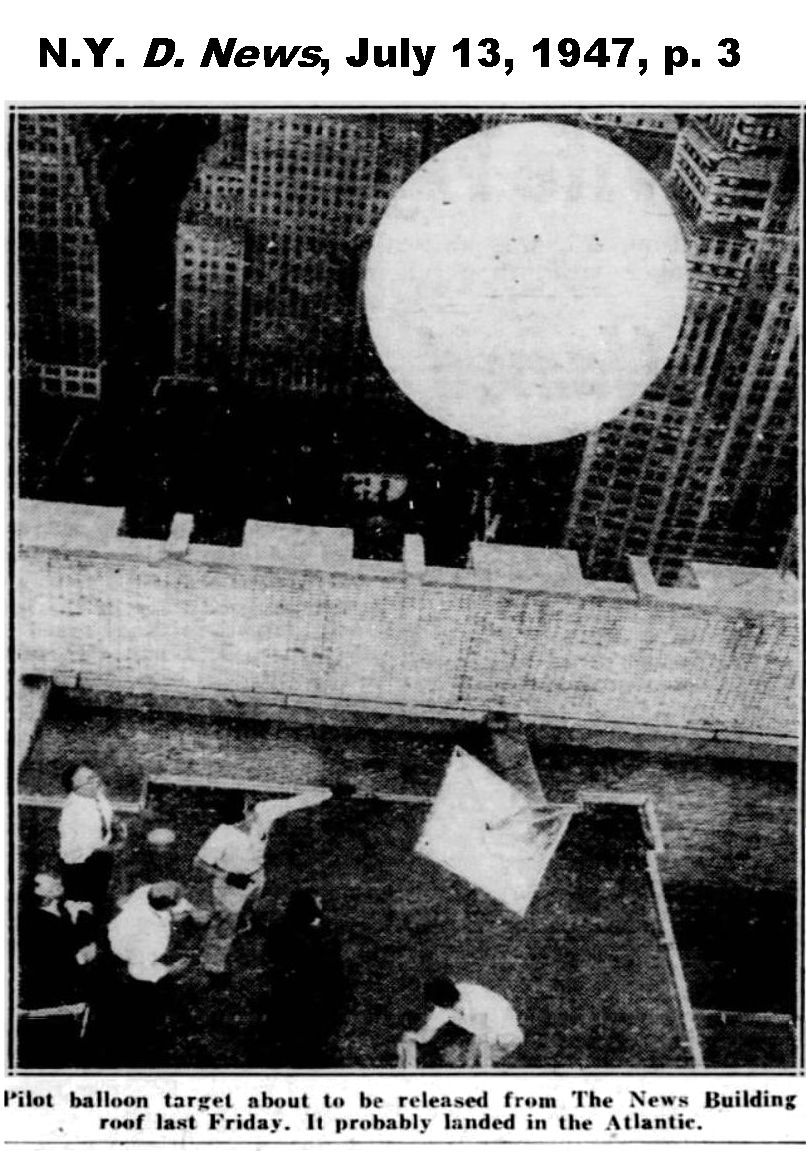
On Friday one of the pilot balloon targets was released from the roof of The News building.
It disappeared within three minutes in the low clouds and News Meteorologist J. Henry Weber figured that it probably landed in the Atlantic, al-
(Continued on page 46, col. 5)
We Unmask The Saucers?
(Continued from page 3)
though when last seen it was headed for Westchester after soaring over the Chrysler and Graybar Buildings. Scores of telephone calls came into The News from persons who saw it. Many of the callers described the gadget as a flying saucer.
According to Weber, on a clear day the object will be visible at a height of three to four miles. Ascending at the rate of 400 feet a minute, it will take 25 minutes to get up to 10,000 feet. The balloon part, Weber said, will not burst until a height of 50,000 feet is reached.
So keep looking up tomorrow, folks, and see if these pilot balloon targets give you the illusion of flying saucers.
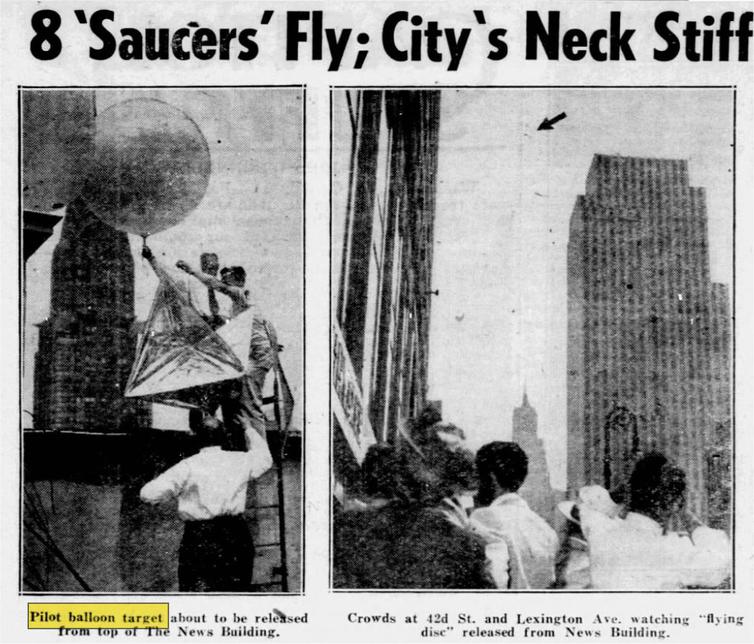
[Photo caption below: Pilot balloon target about to be released from The News Building roof last Friday. It probably landed in the Atlantic.]
N.Y. Daily News, Monday, July 14, 1947 p. 3
Eye Sky at Noon Today For News Saucer Test
Today is the day when New Yorkers may lose the distinction of being practically the only people in the United States who haven't seen flying saucers—we think.
If the saucers are what some whirling disc experts say they are, they are pilot balloon targets of the type that some 80 weather observation stations from coast to coast send up to find which way the wind is blowing.
Acting on the theory, which is a little easier to take than the Man-from-Mars explanation, The News between noon and 1 P. M. today—weather permitting—will send up some helium-filled pilot balloons with targets attached from the roof of the News Building just to find out if they do look like celestial crockery when they get up there. If the weather is bad, the balloon targets will be released between noon and 1 P. M. the first clear day.
A pilot balloon target is made of a group of triangles of paper-backed aluminum foil built on strips of balsa wood and forming four three-sided pyramids
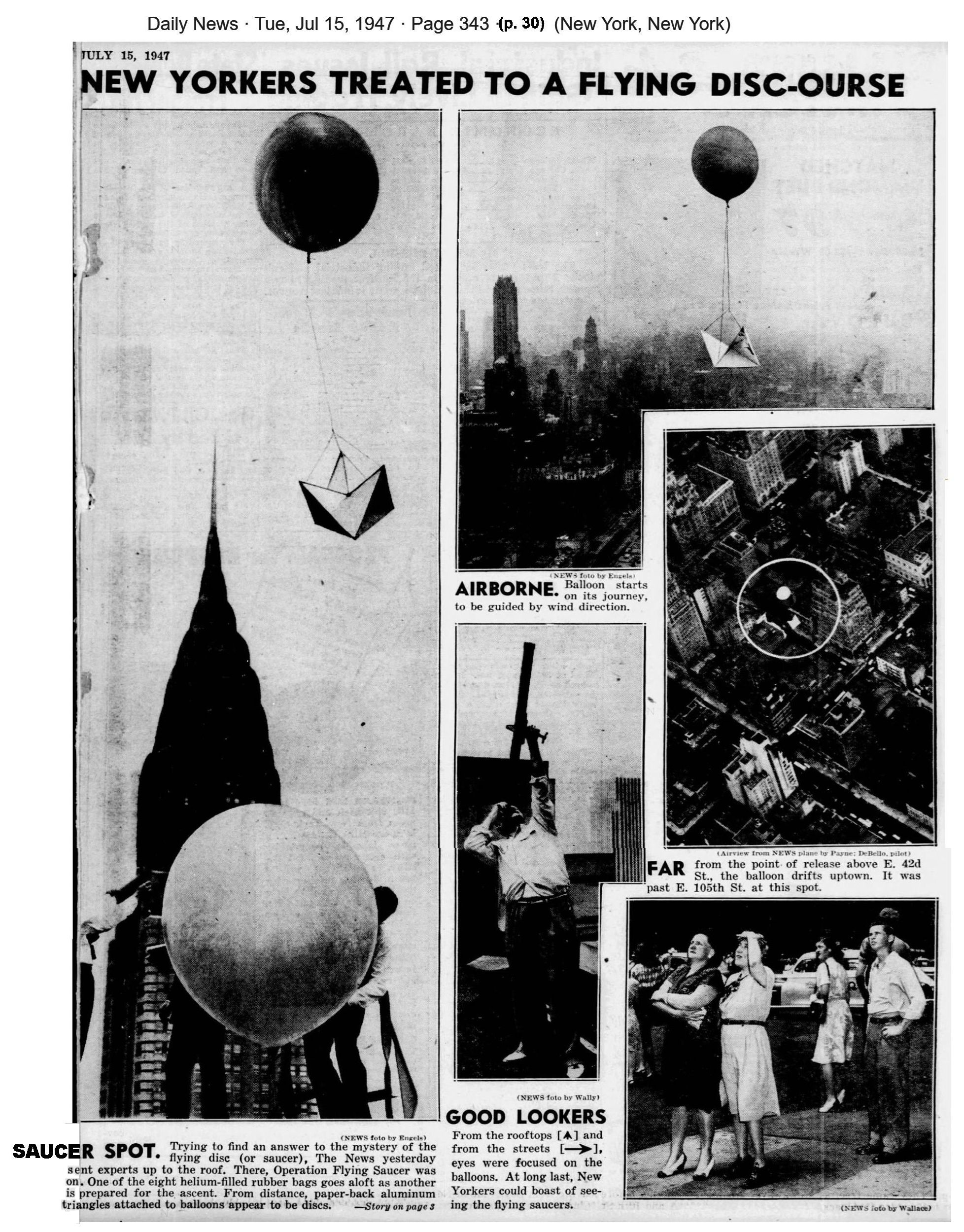
N.Y. Daily News, Tues, July 15, 1947, p. 3
8 'Saucers' Fly; City's Neck Stiff
By Arthur Noble and Neal Patterson
The man phoning The News from 42d St. and Eighth Ave. was excited as all get-out. "I just saw a flying saucer over the midtown East Side!" he yelled.
Other New Yorkers made similar wild guesses in the period just after noon yesterday as Operation Flying Saucer was staged by our whirling disc expert from the top of the 476-foot News Building at 220 E. 42d St.
One Slacker in Group.
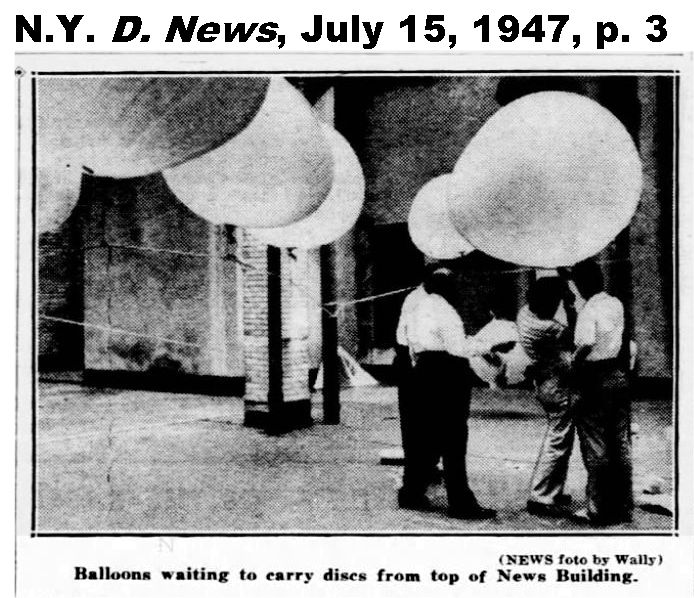
Eight five-foot balloons, each bearing a shimmering pilot balloon target, were sent up between noon and 12:40 P. M. A ninth helium-filled rubber bag, too poorly inflated or too lazy to lift its pilot target, was sent off on its own as a free balloon.
The idea of our experts was to test their theory that a lot of those soaring saucers reported sighted over various parts of the country are nothing more mysterious than free-flying pilot balloon targets. The latter are sent up by some 80 weather observation stations from coast to coast to find which way the wind is blowing.
Well, not everybody who sighted our balloons jumped to the conclusions that the saucers had at last arrived over New York. A lot of callers demanded, "What are those things flying around?"
Pretty Smart Guys Here.
Maybe it just proves New Yorkers are more sophisticated.
But there was a saucer-like suggestion in the outline of those rapidly-climbing objects, particularly when the sun glinted against the triangles of paper-backed aluminum foil which make up the targets. The triangles are built on strips of balsa wood to form four three-sided pyramids.
So our experts consider that their theory was pretty well substantiated, though haze and smoke made visibility none too good over Manhattan during the first half hour.
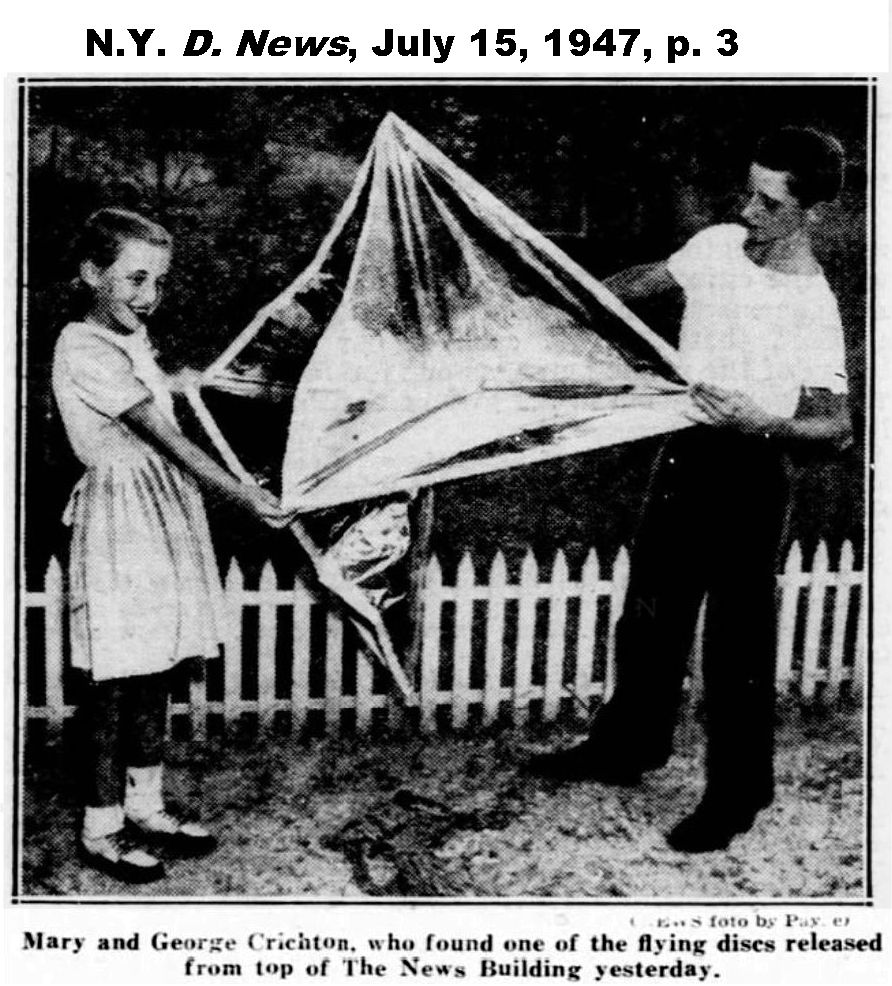
Balloon No. 2, which left The News roof at 12:02 P. M., was the first to be found. It dropped at 2:30 P. M. into the driveway of Mrs. Gladys Fusaro, West Neck Ave., Lloyd Harbor, near Huntington L. I., having burst at an elevation of 40,000 to 50,000 feet, as J. Henry Weber, News meteorologist, predicted it would. It traveled 30 miles.
Balloon 2 obligingly confirmed Weber's calculations on the rate of ascent, wind velocity and changes of wind direction at three separate altitudes, that the initial landings would occur near the Nassau-Suffolk line. Lloyd Harbor is just across the boundary.
Mrs. Fusaro's nephew, George Crichton, 13, saw the target and the deflated balloon just before they hit the driveway.
(Continued on page 27)
8 'Saucers' Fly High; City Necks Get Stiff
(Continued from page 3)
"I was coming home from a swimming the harbor," the boy said. "The outfit fell straight down."
Mrs. Fusaro called The News promptly, complying with a typewritten request pasted in one of the target triangles. Other readers who happened to find collapsed balloon targets used in the tests are requested to do likewise.
Up They Go Together.
The first three balloons left The News roof almost together—at noon, 12:02 and 12:03. Noontime crowds paused in the midtown streets to look skyward. Office workers stared from windows of the Chrysler, Empire State Building and other tall buildings. Numerous watchers congregated on the midtown rooftops. They gaped also from Long Island City and from the East River waterfront.
Mrs. Mary Dockstader of the Hotel 10 Park Ave., 34th St. and Park Ave., phoned The News soon after the first target-carrying sphere was released.
"I saw something that looked like a V-shaped kite attached to a balloon," she said. "The sun reflected particles of light from the kite. As they went higher, both kite and balloon looked about the same size. After a while they resembled two birds flying together."
Weather Favors Last 2.
Others were released at 12:07 P. M., 12:11, 12:17, 12:35 and 12:40. The last two got the best break from the weather, showing in clear sunshine for six or seven minutes until they became tiny dots and vanished to the northeast.
A Paramount newsreel man photographed the roof show and NBC televised it. Lots of New Yorkers saw NBC's television showing last night.
As Meteorologist Weber calculated the route, the first balloons traveled to a point over 90th St. and the East River, then began curving to the east-northeast.
They soared thus over Hell Gate, Triboro Bridge, northern Astoria, Flushing Bay, Whitestone Bridge, Kings Point and the Port Washington vicinity. There they encountered a wind blowing nearly due east, which carried them over Oyster Bay, Cove Neck and Cold Spring Harbor.
Different Route Later.
Later balloons may have deviated from this route, due to changes in the wind. Some may have been blown out to sea.
"If you didn't see them in the air, study The News' pictures. Then you too will be a flying crockery expert—if more of the things come sailing along."
(Other pictures in centerfold) [See below]