
1948
“The Affairs of Dame Rumor” by David J. Jacobson, p. 43, Rinehart and Co.
“Army Air Forces headquarters strongly rebuked officers at the Roswell, New Mexico, air base
for announcing that a ‘flying disk had been found there.’ This saucer created a stir, but finally
was identified as an old weather balloon.”
This is the first clear book reference I have found to Roswell. Jacobs, from the little I can gather on him, was a New York advertising and public relations man, and the book is a cynical look at how easily the public-at-large everywhere can be mislead by rumor, government propaganda, misinformation, etc. (He also wrote a book on rumors and the creation of anti-semitism.) One of many such examples cited by Jacobs was Orson Welles and his 1938 “War of the Worlds” radio broadcast that panicked many Americans.
Jacobs also devotes about 8 pages of his book to the subject of UFOs, starting with the Scandinavian Ghost Rockets of 1946, then leading into the big June/July 1947 flying saucer sightings in the U.S. Jacobs takes a highly skeptical psycho-social view of the sightings and chalks them up to public mass hysteria
Late 1940’s or 1950’s?
Roswell Sheriff’s wife, Inez Wilcox, memoir (Primary source)
Inez Wilcox, wife of Roswell/Lincoln County Sheriff George Wilcox, wrote a memoir briefly mentioning the Roswell incident, now held in the The Roswell Historical Society. Entitled "Four Years in the County Jail", it was about life as the wife of a Western lawman. According to family, she hoped it might be carried one day in a magazine like Reader’s Digest. The relevant part reads:
"One day a rancher north of town brought in what he called a flying saucer. There had been
many reports all over the United States by people who claimed they had seen a flying saucer.
The rumors were in many variations: The saucer was from a different planet, and the people
flying it were looking down over us. The Germans had invented this strange contraption, a
formidable weapon...Since no one had seen a flying saucer (up close) Mr. Wilcox called
headquarters at Walker Air Force Base (formerly RAAF) and reported the find. Before he hung
up the telephone almost, an officer walked in. He quickly loaded the object into a truck and
that was the last glimpse that any one had of it."
"Simultaneously the telephone began to ring, long distance calls from newspapers in New York,
England, France and from government officials, military officials and the calls kept up for 24
hours straight. They would talk to no one but the Sheriff. However the officer who picked up
the suspicious looking saucer admonished Mr. Wilcox to tell as little as possible about it and
refer all calls to the base. A secret well-kept."
Inez Wilcox’s narrative unfortunately lacks detail, compresses two or three days of events into one, and is fairly innocuous as is. It does hint that the military jumped all over the find and basically told the Sheriff to keep his mouth shut to keep something important secret. The newspapers in 1947 mention Sheriff Wilcox fielding calls from all over the country and also England. But one regional AP story mentioned Wilcox being boxed in by the military, as Inez Wilcox wrote. Wilcox refused to answer more questions about what the object looked like that the rancher brought in, stating he was “Working with those fellows at the base.”
The Wilcox family has since said much more. According to granddaughter Barbara Dugger, she got her grandmother to talk in more detail later in her life. The Sheriff had seen the crashed craft and the space beings. The military’s warnings not to talk about it were not friendly. Instead they were death threats. As Dugger wrote in her affidavit
“One evening, while we were watching a TV program about space, my grandmother told
that in the 1940s, there was a spacecraft--a flying saucer--that crashed outside Roswell. She me
told me not to tell anybody, because when the event occurred, ‘the military police came to the
jailhouse and told George and I that if we ever told anything about the incident, not only would
we be killed, but our entire family would be killed.’ I said, ‘Did you believe them?’ She said,
‘What do you think? They meant it, Barbara--they were not kidding.’ She didn't remember the
names of those involved, however, she said it was Air Force personnel who threatened
them. She never told anyone else in the family about the event, even my mother, Elizabeth Tulk.
“She said someone had come to Roswell and told him about this incident. My grandfather
went out there to the site; it was in the evening. There was a big burned area, and he saw
debris. He also saw four ‘space beings.’ One of the little men was alive. Their heads were
large. They wore suits like silk.
“After he returned to his office, my grandfather got phone calls from all over the world--
including England. MPs came to the jail. A lot of people came in and out of the jail at the time.
“She said the event shocked him. He never wanted to be sheriff again after that. Grandmother
ran for sheriff and was defeated. She wrote an article about the event right after it happened to
see if anyone else knew anything about it.”
Note that Dugger mentions the memoir. Dugger's affidavit suggests that Inez Wilcox wrote the article, perhaps not saying too much because of the death threats, hoping it would eventually be published and maybe bring forth more witnesses to corroborate the story. But this is mostly speculation.
July 8, 1948, 1949, 1950, 1954, 1955
The News (Frederick, MD)
July 8, 1952, 1953
The Washington Reporter (Washington, PA)
“Today in History” by the Associated Press
“1947—‘Flying disc’ in New Mexico turns out a battered weather balloon.”
For at least eight years after Roswell, Associated Press’ nationally syndicated “Today in History” column listed the incident along with typically 7 or 8 other historical events in American history that occurred on July 8, such as the cracking of the Liberty Bell in 1835 and William Jenning Bryan’s famous “Cross of Gold” speech in 1896. It is significant that Roswell still made the cut of major American historical events (or at least considered among the most interesting). So again, the Roswell event obviously wasn’t totally forgotten (even if, again, the word “Roswell” was not used).
This would probably be the most common and widely read post-Roswell reference of all listed here, though maybe appearing in only a few percent of all newspapers. (Search engines from Google News and ancestry.com only found the above two newspapers with the column, so maybe only 1% or 2% of the all the digitized newspapers carried the item. Some of the years I had to search for manually, because the search engines didn’t find them.)
Post-1947 Roswell References
It is often claimed that Roswell was totally forgotten after it was ridiculed as a weather balloon in 1947, therefore it was an unimportant "nonevent". But there were actually numerous media mentions of the case and other rumors about UFO crash retrievals maybe related to Roswell prior to the case being revived.
Debunkers of Roswell often make the argument that Roswell was totally, or almost completely forgotten after first reported in 1947 until revived in 1978, when researcher Stanton Friedman stumbled across the base intelligence officer, Jesse Marcel and reopened the case.
The argument then usually goes on that because it was allegedly forgotten, it couldn’t have been important. The reasoning is fallacious and stupid, because even it had been totally forgotten, that doesn’t make it necessarily unimportant or later claims untrue. Many historical events are largely forgotten, or deliberately buried, only to be uncovered decades or even centuries later when somebody stumbles across them and brings them back to life. There are innumerable examples.
Further, the argument about Roswell being forgotten has only a partial element of truth to it. To demonstrate that it was NOT forgotten is the main purpose of this web page. Many counterexamples will be documented below, a long list of publications mentioning the Roswell or similar events before 1978. This by itself, however, doesn’t necessarily make it an event of importance, just as total amnesia doesn’t make it a “nonevent”. It only disproves the claim of Roswell not being mentioned as being historically false.
Others have compiled shorter lists (example 1, example2--some of the items below are taken from these lists), but I decided to look for more. With the digitization of many books, magazines, and newspapers now online (e.g., Google Books and Google News, ancestry.com, Proquest, Newspapers.com), keyword searches can be done (e.g. “New Mexico” + “weather balloon” + “flying saucer”), which turns up substantially more mentions. But even this is likely to fall short, since computer character recognition and search engines have their limitations (bad print copy is one problem). E.g., one 10 year UFO retrospective from 1957 I eventually found in five newspapers on Google News, but it took multiple keyword searches to find them all, even though the article wording was identical. Electronic sources are also limited in number. (Probably only 1-2% of the newspapers or magazines from any era are currently digitized and available for searching.) So the list below is very likely incomplete. Even so, I uncovered at least 20 previously unlisted or unknown direct references to Roswell and several possible indirect references.
In most cases, the allusion to Roswell is either direct or it is indirect but obvious. E.g., many times the word “Roswell” is not used, but it will refer to the case in New Mexico thought to be a saucer but then explained as a weather balloon. Often times, facts will be scrambled, but still the Roswell case is obvious, such as when Look Magazine claimed the weather balloon was found near Fort Worth instead of Roswell. (Fort Worth is where the debris from Roswell was flown to, then immediately debunked as a weather balloon.)
In other cases, it is possible that Roswell had an influence on the story, though there is no obvious reference to Roswell, such as Bernard Newman’s 1948 novel, which included a New Mexico saucer crash, Frank Scully’s 1950 book of three crashed saucers found in New Mexico, a 1950 FBI memo discussing 3 New Mexico saucer crashes, or a well-known airline pilot UFO witness stating in 1954 that the military had UFO crash debris in its possession.
(Note: In Windows, documents and pictures can be viewed full size by right clicking and selecting "View Image".)
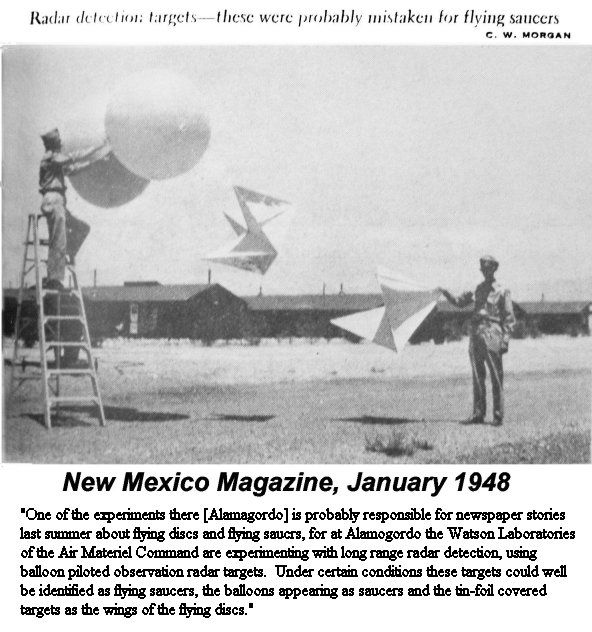
“Radar detection targets--these were probably mistaken for flying saucers
One of the experiments there [Alamogordo base] is probably responsible for newspaper stories
stories last summer about flying discs and flying saucers, for at Alamogordo the Watson
Laboratories of the Air Materiel Command are experimenting with long range radar
detection, using balloon piloted observation radar targets. Under certain conditions
these targets could well be identified as flying saucers, the balloons appearing as saucers
and the tin-foil covered targets as the wings of the flying discs.”
Flying discs with “wings”? The writer seemed a little unclear on what a “flying disc” looked like--like a “disc” perhaps?
January 1948
New Mexico Magazine
I stumbled across this reference quite by accident while reviewing New Mexico Magazine at the New Mexico State Library in Santa Fe. The magazine carried an indirect reference to Roswell in an article on the town of Alamogordo. Included was a photo of the weather balloon, radar target demonstration carried at Alamogordo Army Air Field on July 9, 1947, used to debunk Roswell and the flying saucers after the Roswell ruckus of the day before of recovering a flying disc. Alamogordo AAF was the home of the Mogul balloon launches, used by the USAF in the present day to debunk Roswell.
The Alamogordo event was one of a number of such debunking demonstrations carried out by the military after Roswell. (See "How the Military Debunked the Saucers after Roswell") The photo was the same one published in the Alamogordo News on July 10. The title and caption of the photo in the magazine read:
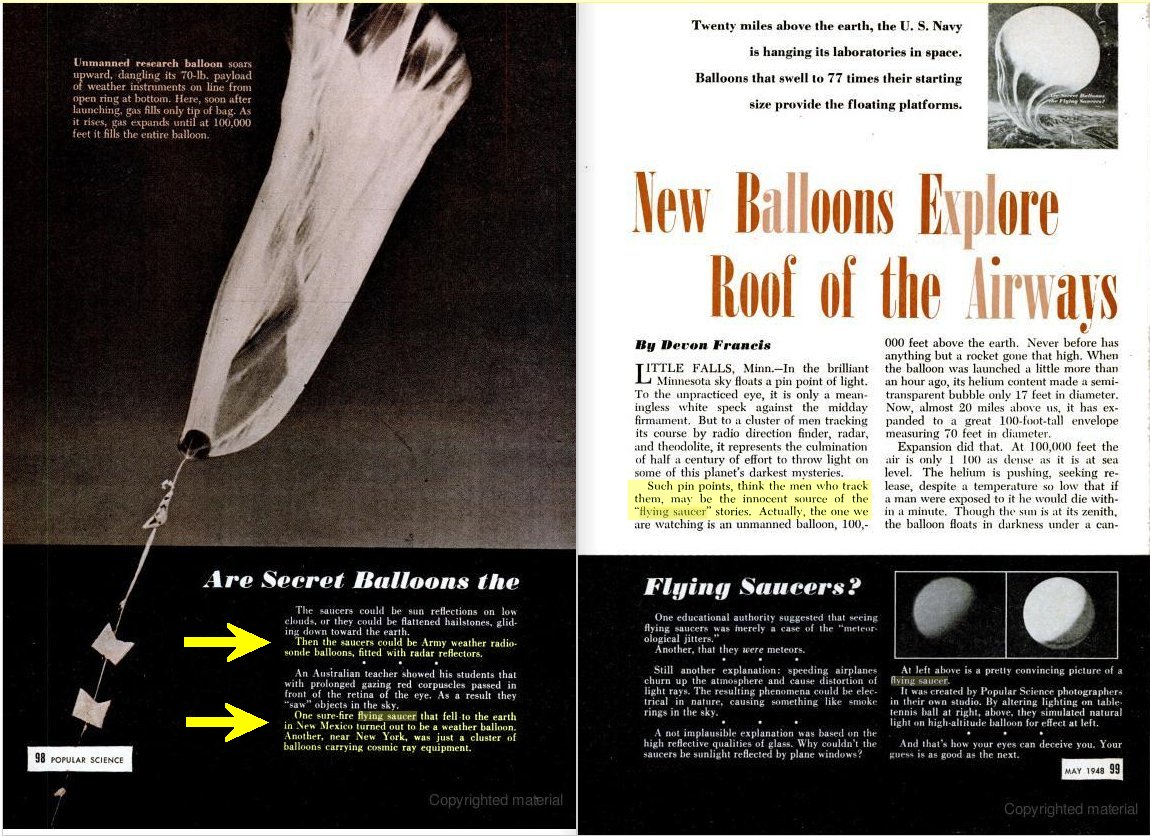
May 1948
"New Balloons Explore Roof of the Airways
--Are Secret Balloons the Flying Saucers?"
This article debunked flying saucers as various types of balloons and carried an obvious reference to Roswell, but did not use the word. A photo caption read:
"One sure-fire flying saucer that fell to the earth in
New Mexico turned out to be a weather balloon.”
There was also a reference to a balloon train flight that occurred right after Roswell and was widely reported in newspapers. (See Princeton balloon flight) “Another, near New York, was just a cluster of balloons carrying cosmic ray equipment."
This cover-page article (and title on cover) began with gratuitous debunkery of the "flying saucers" as Skyhooks and other balloons carrying radar reflectors, the final debunking explanation used for Roswell. ("Are Secret Balloons the Flying Saucers?: ...the saucers could be Army weather radiosonde balloons, fitted with radar reflectors.") The main portion of the article detailed the new Skyhook balloon program, which was derived directly from Project Mogul. Project Mogul balloon flights had already been used as part of the flying saucer/Roswell debunkery campaign immediately after the Roswell. (Again, see Alamogordo demonstration above.) Although sensationally called "secret balloons," the Skyhooks were anything but secret and were used as standard explanations for flying saucers for years afterward. (see Project Mogul UFOs and Balloon UFO sightings)
The P.S. article also has many descriptions and photos of the balloon equipment, also used on Project Mogul, none of it really secret. Finding of such unclassified equipment by a rancher would not be considered important and trigger a strong reaction by the military, as happened at Roswell.
1948--World Almanac and Book of Facts, p. 758 (Added July 2026)
Chronology--July 1947: "A 'flying disk' which descended on a ranch in New Mexico was identified as an Army weather balloon."
1948--Information Please Almanac (Google Books--no longer viewable)
Another obvious and sketchy reference to Roswell, again without the word “Roswell”:
“People in forty-four states reported seeing luminous "flying saucers" that scooted through the night
sky at tremendous speeds. Were they a secret weapon developed by the US— or was Russia
bombarding us? Finally the Army captured one on the ground in New Mexico; it was an
innocent, shiny weather balloon.”
June 1948 (but written in late 1947)
“The Flying Saucer”, by Bernard Newman
This is a novel with no direct reference to Roswell, but includes several elements of it, thus perhaps inspired
by it. It is certainly the first book involving the idea of crashed saucers, predating the more widely known
Newman was a prolific British writer of fiction, including many spy novels. He was also a somewhat shadowy character with suspected ties to British intelligence, also accused of being a double agent for the Germans.
Thus there has been speculation that maybe he incorporated into the novel some rumors or actual knowledge
of Roswell he had through intelligence sources. Newman writes himself in as a major character in the novel and even brags on the second page of “The Flying Saucer” that another of his novels, “Secret Weapon”, about a new bomb that would bring an early end to the war, was based on his knowledge of development of the super-secret A-bomb. That suggests he was indeed closely tied in with intelligence sources. But perhaps Newman was merely inspired by newspaper articles on Roswell and intelligence ties had nothing to do with it.
Newman’s novel derides the recent flying saucer wave in the U.S. and the Scandinavian “ghost rockets” of
1946. But he then has a cabal of elitist scientists and rogue intelligence people, including himself, conspiring to exploit the publicity about the flying saucers to unify the nations of Earth against a fictional Martian threat. (The idea that such a threat would unify the planet was not exactly new, though I have seen Newman erroneously being given credit as the first to think it up.)
There are elements here of a Roswellian “Majestic 12” type group of scientists, the head scientist, named
"Drummond," also being responsible for the development of the secret bomb in Newman’s novel “Secret Weapon”. “Drummond” thus sounds partially modeled on Dr. Vannevar Bush, who headed U.S. military research and development during the war, including, initially, the Manhattan Project. Bush was also the rumored head of “Majestic 12”, the group allegedly set up by Pres. Truman in Sept. 1947 to oversee investigation of the saucers following Roswell. (See Smith papers of Canadian documents pointing to Bush as heading up such a group within the Defense Departments Research and Development Board.) "Drummond" also has some similarities to Sir Henry Tizard, sort of a Bush UK counterpart, who became the Ministry of Defence's Chief Scientific Advisor in 1948 and headed up the British Flying Saucer Working Party investigation in 1950.
The scientists initially stage three crashes of Martian “saucers” (really more missile-like), including one in New Mexico, of all places (but seemingly closer to Santa Fe). Like Roswell, the crash remains include previously
unknown exotic, hard metals extremely difficult to cut through and thin metal sheets on the inside with
“hieroglyphics” that need to be decrypted. There is also an autopsy on the pulverized remains of a hoaxed
“Man from Mars.”
March 22, 1950
FBI memo on New Mexico crashed saucers
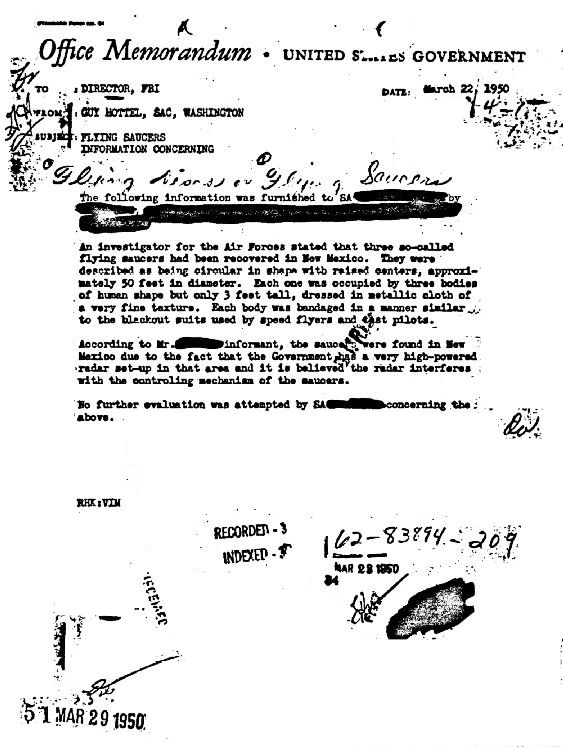
According to this genuine FBI memo to director J. Edgar Hoover, an “investigator for the Air Forces” told the FBI of three flying saucer crashes in New Mexico. The story has similarities to the one related by Scully at the same time, so there is strong suspicion that a further unnamed “informant” was also Scully’s source or passing on the same information from the source. (But would he have been referred to as an "Air Force investigator," the other cited source?) Again, it is unclear if one of three saucer crashes refers to Roswell. There is no suggestion, e.g., that one of the craft had exploded and left behind a lot of debris. The memo reads in part:
“An investigator for the Air Forces stated that three so-called
flying saucers had been recovered in New Mexico. They
were described as being circular in shape with raised centers,
approximately 50 feet in diameter. Each one was occupied by
three bodies of human shape but only 3 feet tall, dressed in
metallic cloth of a very fine texture… According to Mr.
XXXXXX [redacted], informant, the saucers were found in
New Mexico due to the fact that the Government has a very
high-powered radar set-up in that area and it is believe the radar
interferes with the controling [sic] mechanism of the saucers.”
The likely reason Lang used this otherwise nothing case was because it was included in a 22-page saucer debunking press release by the Defense Department (referred to then as the “National Military Establishment) from April 27, 1949.
“Early in the saucer sensation -- mid July of 1947 -- capture of a "flying disc" excited residents
of Jackson, Ohio. Later, however, the "saucer" was identified as a U.S. Army Signal Corps
Radiosonde Transmitter used for gathering weather data.”
The Jackson balloon non-event, in turn, seemed to be the introduction to a debunkery section on “BALLOONS”: “Various weather and research balloons have been found at the source of a great number of saucer incidents…”
[A Google Books search also turned up the exact same DOD quotes above in a 1950 Irish Army publication: An Cosantóir: Volume 10, Issue 9, Ireland. Army. Southern Command, Ireland. Army]
In contrast to Jackson, the nearby Circleville, Ohio weather balloon radar target recovery from July 5/6, 1947 received a fair amount of newspaper coverage nationwide, including well-circulated photos (see my web page on Circleville), and was the first instance of where weather balloons and accompanying aluminum foil balsa wood targets were broadly suggested as a possible solution to the new flying saucer mystery.
But even the relatively well-publicized Circleville pales in comparison to the newspaper coverage of the Roswell “flying disc” radar target debunking of July 8, which ran in practically every newspaper in the country (usually on the front page, sometimes being the headline story), including even more widely circulated photos of the weather balloon and radar target. It has even been proposed that the military’s Roswell radar target debunkery was inspired by Circleville. (I, for one, am personally of that opinion.)
This begs the question, why cite the non-publicized Jackson case that hardly anybody knew about and never caused a stir? Why not Roswell, or even Circleville? Perhaps the military in their 1949 press release deliberately mixed up the unknown Jackson case as a classic military diversion from or trivialization of the well-known and perhaps related Circleville and Roswell cases.
So bringing up the Jackson, Ohio case may be related to Roswell in a very oblique way, but it is hard to tell.
Then the probably unknowing Lang in his 1952 article parroted the Pentagon propaganda, citing Jackson as an inane paradigm example of where civilians "excitedly" confused a weather balloon with a flying disc.
Lang also repeated word-for-word his New Yorker story about “Jackson, Ohio” in two later books, “The man in the thick lead suit” (1954) and “From Hiroshima to the moon: chronicles of life in the atomic age” (1959).
Ironically, right after Jackson, Lang also mentions a meteor fireball case from 1948, that exploded over Kansas. What Lang didn’t know, was that the Army Counterintelligence Corp (CIC) initially treated the situation with dead seriousness as a possible crashed saucer. (Newspapers even reported the military sending out planes to conduct searches.) Their consultant, astronomer Dr. Lincoln LaPaz of the Univ. of N.M., then quickly determined it was almost certainly a meteor bolide, at which point the CIC dropped their investigation of the case. This is the mystery anonymous “astronomer” referred to by Lang in his article, who he further erroneously claims discovered the meteorite remainders after “following a hunch” two months later. Rather, LaPaz methodically determined the fireball trajectory by interviewing witnesses (LaPaz's specialty), then organized a large search party to search the probable impact point. To add to the ironies, LaPaz has also been tied in with the Roswell case by several witnesses, who said he was called in by the CIC afterward to try to determine the crash object trajectory by interviewing witnesses. (see, e.g., affidavit of Earl Zimmerman)
So again, a distant echo of Roswell in the article.
Sept. 6, 1952
The New Yorker Magazine
“A REPORTER AT LARGE: SOMETHING IN THE SKY”,
by Daniel Lang
Maybe this item doesn’t belong here, but, depending on interpretation, there may be distant references to Roswell in it. Daniel Lang was a frequent contributor to the The New Yorker. Lang did a skeptical and often factually inaccurate article on flying saucers with the following item:
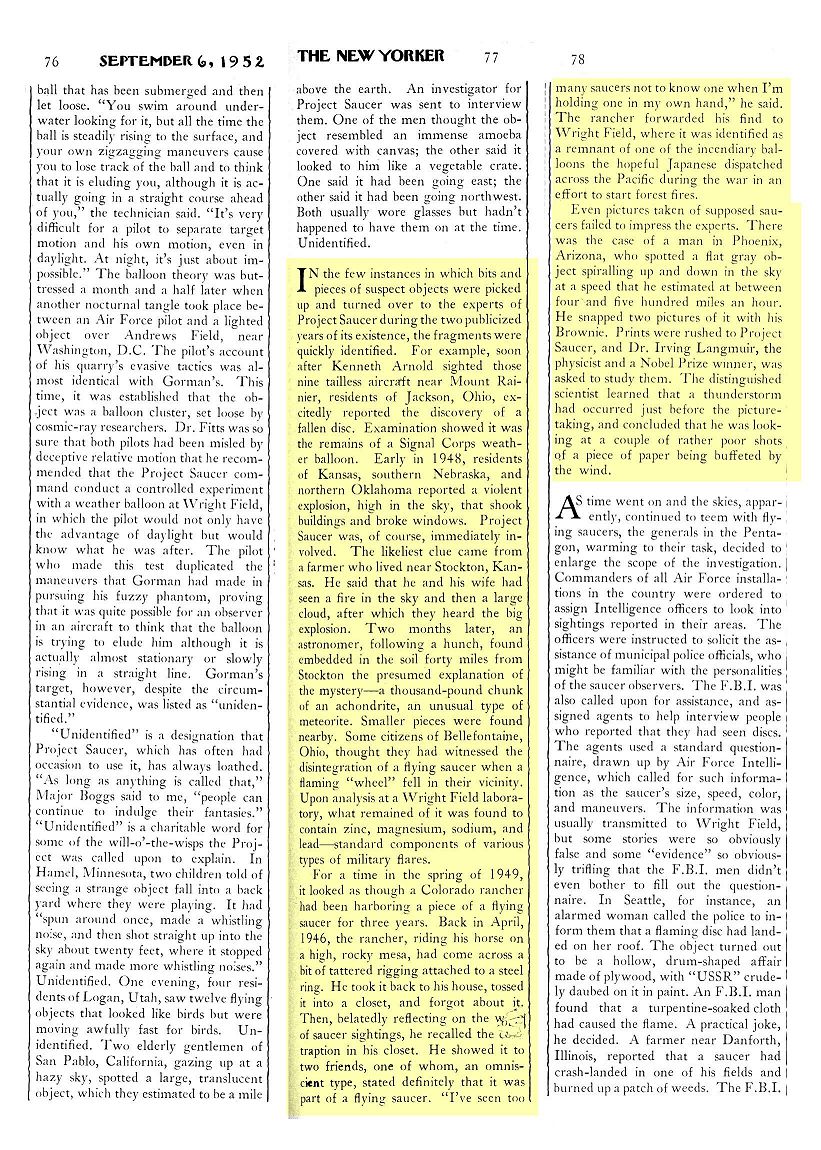
“In a few instances in which bits and pieces of suspect objects
were picked up and turned over to the experts of Project Saucer
[officially “Project Sign”] during the two publicized years of its
existence, the fragments were quickly identified. For example,
soon after Kenneth Arnold sighted those nine tailless aircraft
near Mount Rainier, residents of Jackson, Ohio, excitedly
reported the discovery of a fallen disc. Examination showed it
was the remains of a Signal Corps weather balloon.”
First of all, Project Sign/Saucer didn’t exist at the time of Roswell (July 1947), not being created until the end of 1947. So they couldn’t have analyzed anything. Rather it was the Army Counterintelligence Corp (CIC).
It is also strange that Lang referenced the Jackson, Ohio weather balloon incident of July 21, 1947, which received no newspaper publicity, and is just
a highly obscure case in Project Sign files. (I personally had never heard of it, until I stumbled across it in this New Yorker article and looked it up.) There is also no indication that anybody in Jackson was particularly "excited" about it or many people were involved. According to the eventual CIC writeup, a vagrant who lived in a hut on somebody else's property 2 miles out of town found it in a tree, turned it over to a neighbor, who apparently turned it into the Sheriff, who contacted the Army and the CIC. It certainly doesn't sound like the entire town of Jackson was freaking out over a recovered flying disc.
Spring 1955
Flying Saucer Review (Vol 1, No. 1)
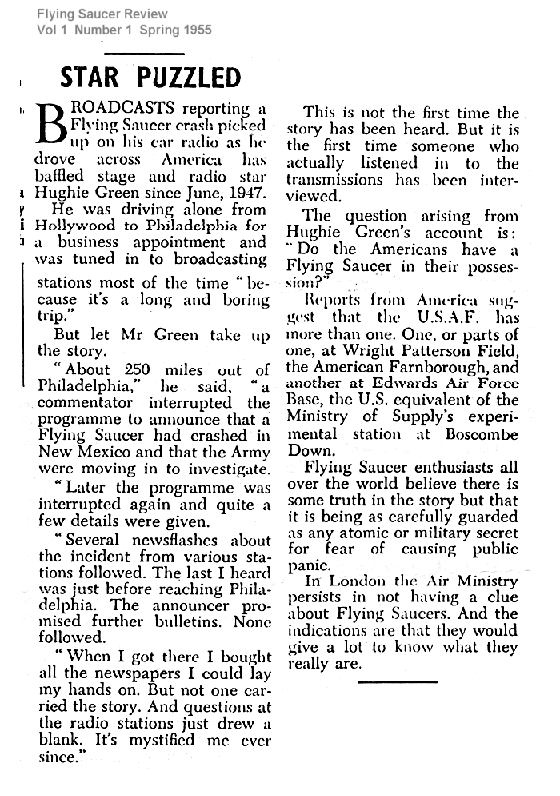
This is a well-known early Roswell reference. The first issue of FSR briefly recounted the experience of Hughie Green, an English military navigator during WWII and later a well-known entertainer. While driving across the United States in the summer of 1947, Green said he heard radio reports that a saucer, "Had crashed in New Mexico." Greene was particularly puzzled by his inability to learn more about the story when he arrived on the East Coast:
"About 250 miles out of Philadelphia, a commentator
interrupted the programme to announce that a flying saucer
had crashed in New Mexico, and that the Army were moving
in to investigate. Later the programme was interrupted again,
and quite a few details were given. Several news flashes about
the incident, from various radio stations, followed. The last I
heard was just before reaching Philadelphia. The announcer
promised further bulletins. None followed. When I got to
Philadelphia I bought all the newspapers I could lay my hands
on. But not one carried the story. And questions at the radio
stations just drew a blank. It’s mystified me ever since."
Green’s FSR story is interesting, because his memory is that the radio stories specifically mentioned an actual flying saucer crash. The word “crash” was almost never used in newspaper stories, instead saying that a flying saucer or flying disc had been recovered. Oddly, Green recalled the story completely disappeared, and doesn’t seem to have heard or remembered that the crashed saucer story had been replaced with a misidentified weather balloon. I have the Philadelphia Inquirer story from the morning of July 9, 1947, and it certainly DOES mention Roswell and carried a picture of the weather officer holding the identified radar target. (See 1967 and photo below)
FSR then goes on to comment:
“This is not the first time the story has been heard. But it is the first time someone who
actually listened in to the transmissions has been interviewed. The question arising from
Hughie Green’s account is: ‘Do the Americans have a Flying Saucer in their possession?’
Reports from America suggest that the U.S.A.F. has more than one. One, or parts of one,
at Wright Patterson Field… and another at Edwards Air Force Base… Flying Saucer
enthusiasts all over the world believe there is some truth in the story but that it is being as
carefully guarded as any atomic or military secret for fear of causing public panic.”
Thus, FSR clearly indicates that the Roswell story was far from forgotten (at least among the “Flying Saucer enthusiasts”), and lore about Roswell debris being stored at Wright-Patterson already well in the public record. Also notice rumors about more than one crashed saucer, which again pop up. (See Olavo Fontes letter below)
Green’s story was again mentioned in the first Roswell book, the 1980 “The Roswell Incident” by Charles Berlitz and William Moore. In January 1979, Moore and Berlitz began corresponding with Green in the process of gathering information on Roswell for their book. Moore was further able to learn that Green’s experience happened in early July 1947, but Green remembered nothing else of significance.
In 1995, Green wrote a letter where he denied being in the U.S. in 1947, and instead this happened in 1957 while he was driving cross-country, and that the radio reported Tucumcari, N.M., not Roswell. Obviously Green was at least confused about the date, since he first reported his story in 1955 to FSR, as was pointed out to him, and he agreed in further correspondence. Green’s story also varied in saying that the Sheriff and his men, not the Army, had moved in to investigate. In the Roswell story today, both elements are present.
Nov. 11, 1957
“10 Years of Flying Saucers”
Nov. 11, 1957
“Ten Years of Flying Saucers:
Trying To Track Ghost Riders In Sky Has Cost 9 Lives, 4 Planes And Millions”
Nov. 11, 1957
“Ten Years of Flying Saucers:
Sputnik Is First Authentic Space Traveler Sighted Since Intensive Hunt For Saucers Began”
Also reprinted in Baltimore Sun (Nov. 11) & Hartford Courant (Nov 16)
By Don Moore
This highly skeptical 5-part newspaper recap of 10 years of saucer sightings and Air Force investigations goes a little bit into the history of the phenomenon. It is interesting that it also highlights some of the pilot deaths that had occurred chasing UFOs, such as the Thomas Mantell Case of 1948 and the Kinross case of 1953, where the jet interceptor and crew disappeared and have never been found. Author Moore was described as an “editor-researcher-science writer.” It is unclear if he is the same Don Moore who originally wrote storylines for the Flash Gordon comic strip.
Midway in the first article we get the following ambiguous reference to Roswell in 1947, after first quickly summarizing the events that led up to it:
“…The flying saucer saga started June 24, 1947 when Kenneth Arnold, of Boise, Idaho, ...
Newspaper stories were quickly followed by new sightings by an airplane crew [United
Airlines sighting of July 4 near Boise, Idaho] and by military technicians and flyers at
Muroc, Calif., Air Force Base and other Western testing areas… [These occurred on July 8]
“The military sightings led to fruitless photographic and survey flights by the Oregon National
Guard and 250 Wisconsin Civil Air Patrol planes. The first photographed saucer proved
to be a weather balloon, as did a UFO over a New Mexico bomb-test area.”
“The first photographed saucer” probably references either the Circleville, Ohio, crashed weather radar target [photographed around July 6] or the photo taken by Coast Guardman Frank Ryman over Seattle on July 4, which was also allegedly due to a weather balloon. The photos in both cases received relatively wide circulation.
The photographed “UFO over a New Mexico bomb-test area” is probably another confused and oblique reference to Roswell, which was a nuclear bomber base, not a bomb-test area (possibly further confusing it with the Trinity A-bomb test site near Alamogordo). Of course, there was never a public photo of a UFO over the base or nearby and the published photographed Roswell “UFO” was the weather balloon in Fort Worth, Texas, displayed by Gen. Ramey to quickly explain away the Roswell base press release that they had recovered a flying disc.
1955, 1956, 1966
References by radio host and author Frank Edwards
Frank Edwards Public Lectures (October 27, 1955; April 28, 1956)
At a UFO gathering in New York City where Edwards was the featured speaker, he was asked by a member of the audience if there was any evidence that any of objects have crashed? Official transcripts recorded at the meetings show that Edwards responded with:
"I'm not too sure some of them haven't. Way back in 1947, at Roswell, New Mexico, a
farmer reported he saw something strike a mountainside and crash. According to what I was
told, they threw troops in a circle all around that place, and would let nobody in for five
days. Finally they came up with a picture of a man holding a little crumpled kite with
aluminum foil on it --- a radar target --- they said this was it --- believe it or not. There have
been many other rumors since then of saucers having crashed. I don't know whether there's
any truth in them."
It is interesting here that Edwards says “according to what I was told,” suggesting he was basing his comments not on old newspaper stories, but on an informant or informants. The same may be true for the next Edwards' item:
UFOs-Serious Business (1966)
On page 76 Edwards basically repeats his 1956 response:
"There are such difficult cases as the rancher near Roswell, New Mexico, who phoned the
Sheriff that a blazing disc-shaped object had passed over his house at low altitude and had
crashed and burned on a hillside within view of the house. The Sheriff called the military;
the military came on the double quick. Newsmen were not permitted in the area. A week
later, however, the government released a photograph of a service man holding up a box
kite with an aluminum disc about the size of a large pie pan dangling from the bottom of
the kite. This, the official report explained, was a device borne aloft on the kite and used to
test radar gear by bouncing the signals off the pie pan. And this, we were told, was the sort
of thing that had so excited the rancher. We were NOT told, however, how the alleged kite
caught fire, nor why the military cordoned off the area while they inspected the wreckage
of a burned-out box kite with a non-inflammable pie pan tied to it."
There are a number of mistakes in Edwards' recounting of Roswell, but he has some elements correct, such as the rancher reporting to the Sheriff and a radar target being used to explain what the rancher allegedly found. Particularly interesting is Edwards mentioning a military cordon that lasted for days, something that wouldn’t emerge in eyewitness testimony for another two or three decades. Nothing about a cordon appeared in the newspapers in 1947.
One website, run by someone calling himself "The Wanderling," claims that at 8 years old, while in the care of his uncle, a Santa Fe artist, they were eyewitnesses to parts of the Roswell incident. His uncle, who was highly familiar with the New Mexico desert, attempted to reach the crash site and skirt the cordon. The Wanderling says his uncle later contacted Edwards about 1955 and was his source for the story. The uncle also claimed to be an eyewitness to the alleged May 1953 Kingman, AZ saucer crash and also tried to tell Edwards about that. This may be why Edwards in his 1956 talk states "There have been many other rumors since then of saucers having crashed. I don't know whether there's any truth in them."
Feb. 27, 1958
CONFIDENTIAL letter, written by Dr. Olavo Fontes to the Aerial Phenomena Research Organization (APRO),Tucson, AZ (now defunct)
Fontes was a medical doctor in Brazil and their foremost UFO researcher, which included investigation of a possible UFO crash in Ubatuba, Brazel in 1957, including metal fragments allegedly recovered from the crash (and which are STILL being analyzed). The letter is about a briefing Fontes said he had from two Brazilian Naval intelligence officers in exchange for metal pieces from Ubatuba They told him there was absolute proof that the saucers existed, because six had crashed and been examined, plus alien bodies had been recovered. Three of the crashes were in the U.S., though Roswell was not specifically mentioned. (The similarity to the “three N.M. crashes” from the 1950 Scully book and FBI memo are obvious.) As with Roswell, all craft were made of a very light metal. As with Roswell, the bodies were humanoid and 32 - 46 inches tall. The beings were believed hostile and a massive world-wide cover-up was in effect by various militaries, since there was no defense. Because of this, any means necessary to debunk the reality of the saucers could be used, including censorship, disinformation, ridicule, threats and force against witnesses, including at times assassination. Thus, many elements of the Roswell case that emerged later are in this letter (including threats against witnesses), though Fontes was probably unaware of the Roswell case.

Although there are similarities to the Scully story, there are also significant differences. In Scully's book the three discs were 100 feet, 72 feet, and 36 feet in diameter. In the FBI telegram, all three are 50 feet. Scully reported 34 bodies recovered; the FBI memo only 9. Scully referred to the bodies as those of little men; the FBI memo has them of "human shape" or humanoid. Scully has them dressed in old-style human clothing; the FBI memo has them in a "metallic cloth" (a description also sometimes applied to some of the Roswell debris, and also described in other humanoid sightings). Ironically, as I was putting this Webpage together in March/April 2011, this memo got "rediscovered" by the media and garnered a lot of publicity and discussion, even though it has been pretty well known in Ufological circles for 30+ years.)
March 23, 1954
AP story of Air Force denying it had flying saucers parts
(many newspapers)
Examples:
Spokane Daily Chronicle, p. 1
Air Force Denies Reports of Finding 'Saucer' Parts
Meriden (CT) Journal, p. 1
Air Force Terms As Baseless Reports It Recovered Parts Of Flying Saucers
by Vern Haugland, AP Aviation Reporter
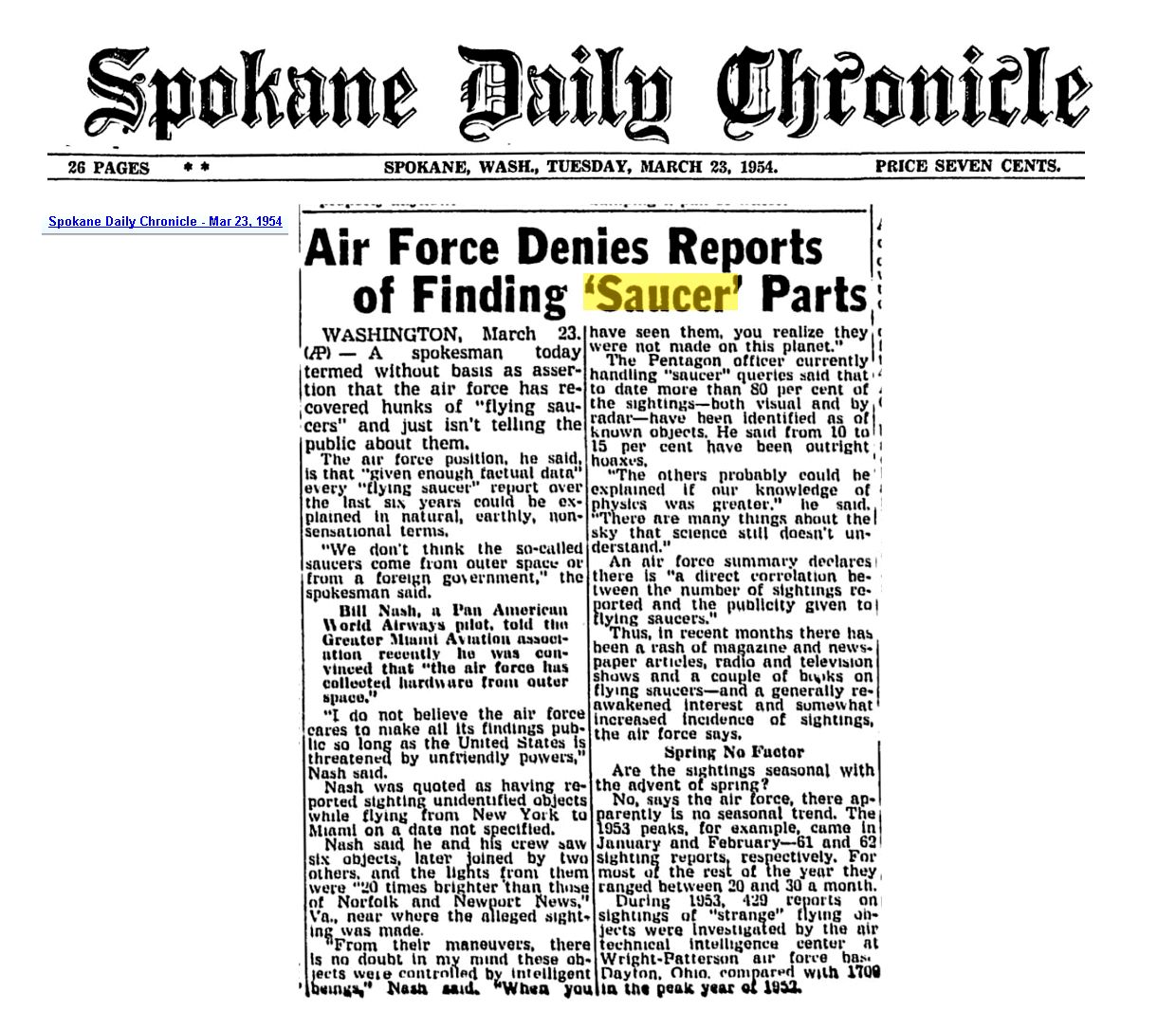
This AP story ran in numerous newspapers, usually on the front page. I found at least a dozen examples over on Google News, just two listed above.
"WASHINGTON, March 23 (AP)--A spokesman today termed without basis as assertion that
the Air Force has recovered hunks of 'flying saucers' and just isn't telling the public about them...
Bill Nash, a Pan American World Airways pilot, told the Greater Miami Aviation association
recently he was convinced that 'the air force has collected hardware from outer space. I do not
believe the air force cares to make all its findings public so long as the United States is threatened
by unfriendly powers,' Nash said.
"Nash was quoted as having reported sighting unidentified objects while flying from New York to Miami on a
date not specified. Nash said he and his crew saw six objects, later joined by two others, and the lights from
them were '20 times brighter than those of Norfolk and Newport News,' Va., near where the alleged sighting was
made. 'From their maneuvers, there is no doubt in my mind these objects were controlled by intelligent beings,'
Nash said. 'When you have seen them, you realize they were not made on this planet.'"
BACK STORY: The UFO sighting of pilot William Nash and his co-pilot William Fortenberry is a very famous one in UFO history (Sample news story Miami News 7/16/52; NICAP writeup and links). It occurred July 14, 1952 but wasn't reported in the press until July 16. The pilots reported at that time being intensively interrogated for details by the military and civilian authorities. Fortenberry died in a plane crash in 1957, but Nash continued to speak out about the ET origins of what he and Fortenberry had seen and also being told that the military had saucers in their possession.
Leonard Stringfield in his first crash/retrieval report in 1978 (see below) notes contacting Wright-Patterson after Nash's 1954 statements and being told that the idea that the Air Force had possession of saucers was "ridiculous." Stringfield in the same report (Abstract IV) also quoted Nash from an interview, reported in the March 1965 issue of Saucer News, edited by Jim Moseley (now the editor of the debunking Saucer Smear). The article was titled "Reconsidering The Mysterious Little Men," by Keith Roberts. According to Nash:
"Before the interview [interrogation by military intelligence officers right after their sighting], Fortenberry and I had
agreed to ask the Intelligence men if there was any truth behind the rumor that the Air Force had one or more saucers
at Wright-Patterson Field. Bill remembered to ask, and on of the investigators said 'Yes, it is true!' Later, when we
were all in one room following separate de-briefings, I remembered to ask the question. All the investigators opened
their mouth at the same time to answer, but Major Sharp, who was in command, broke in with a quick 'NO!' It
appeared as if he was telling the others to shut up..."
In addition, the article said:
"Nash said that an unnamed informant told him that LIFE magazine had been briefed by U.S. intelligence to the effect
that the government does have crashed saucers..."
UFO historian Jerry Clark also reported in his 1993 book, "UFO Encounters and Beyond" that Nash told of meeting three different reporters who claimed that the A.F. likewise briefed them about the recovery of a crashed UFO.
Again, there is nothing specific here about Roswell or what crashed UFOs or debris recovery were being referenced, but if nothing else, the above AP news story and Nash's comments afterward confirm that rumors about crashed UFOs at Wright-Patterson continued to circulate well after Roswell, and even after the information of Scully's book had been discredited as a hoax in 1952.
Some interpret the information about recovered flying saucer debris as not being about Roswell but referencing a piece or pieces of metal or other material allegedly shot off a disc or discs during the UFO flap of July,1952 (See July 29, 1952 Shoot-down news stories). Much of this story was told by Canadian engineer Wilbert Smith (see above) and Rear Admiral Herbert Knowles (Office of Naval Intelligence) in various interviews, Smith saying he had been given the piece for analysis and later showed it to Knowles, which Knowles confirmed (testiony; testimony). Naval Commander Alvin E. Moore said he recovered a piece of anomalous, heavy, manufactured "stone" that fell on his Virginia property, first found July 23, 1952, which he believed came off one of the reported saucers flying over the area at the time. This is covered in great detail in a reprint of his diary, "The Secret UFO Diary of CIA Operative Comm. Alvin E. Moore." Thus there is some indirect corroboration for Nash's story of being told that the military had saucer debris around the time of his sighting in July 1952.
In addition, Smith's son James said his father on his deathbed in 1962 confirmed being shown small recovered alien bodies by the U.S. military and also observed military couriers delivering UFO metal debris to his father for analysis. (March 16, 2002 Strange Days Indeed #179 interview with Errol Bruce Knapp) Canadian researcher Grant Cameron also interviewed James Smith, who told him the same story, and further spoke with Smith's metallurgist, who said the military had "tons" of the stuff, and had even sent them a piece of Roswell debris for analysis. Cameron details much of this on his website.
September 15, 1950 Wilbert B. Smith Interview with Dr. Robert Sarbacher
and 1980s interviews with Sarbacher
A few days after Frank Scully's book on crashed N.M. saucers came out, and also around the same time that Major Donald Keyhoe's first book on flying saucers ("Flying Saucers Are Real") was published, accusing the military of covering up the reality of the saucers, Canadian radio engineer, Wilbert Smith, while visiting Washington D.C. at a convention, sought the assistance of the Canadian embassy there in determining the reality of the flying saucers. This led to an interview with Dr. Robert Sarbacher, guided missile expert and a consultant to the Defense Department's Research and Development Board (RDB).
According to Smith's handwritten notes, when Smith asked about Scully's book, Sarbacher confirmed that the "the facts reported in the book [i.e., crashed saucers] were substantially correct" and the flying saucers were quite real. He said a top-secret project classified higher than the H-bomb had been undertaken to determine the "modus operandii" of the saucers, i.e., how they worked (back engineering). Other Smith and Canadian embassy documents indicate the secret saucer project was taking place within the RDB.
Smith followed up the Sarbacher interview on November 15, 1950, by writing a famous top-secret memo to the Canadian Dept. of Transport, for which he worked. Besides summarizing the interview with Sarbacher, Smith discussed conversations with Dr. Omand Solandt, chairman of the Canadian Defence Research Board (DRB), giving the green light to Smith's proposed research into flying saucer propulsion and promising DRB help and cooperation. Smith also named Dr. Vannevar Bush, wartime science czar, as heading up the secret group within the RDB. Bush is like the "Drummond" head scientist character in Bernard Newman's crash saucer novel above.
(See Smith papers for more details. The original finder of the Smith documents in 1978 was Canadian researcher Arthur Bray, whose name also comes up in another New Mexico crashed saucer story from 1974--See Robert Spencer Carr below.)
When approached in 1983, Sarbacher in a letter to researcher William Steinman confirmed the 1950 interview and said his information from "official reports" was that "certain materials reported to have come from flying saucer crashes were extremely light and extremely tough." Sarbacher also spoke of being told informally of the lightweight construction of the aliens, more like that of insects, to reduce inertial forces.
According to author Whitley Strieber, he phoned and spoke to Sarbacher shortly before his death in 1986, and Sarbacher reported details of the Roswell debris, which he compared to a fabric (see also Roswell debris descriptions). Quote from Strieber's 1995 book "Breakthrough": (according to Strieber, in an email to me, he wrote this down from memory immediately afterward and felt it an accurate representation of what he was told):
"That fabric we obtained at Roswell had molecular welds so small you couldn't even identify
what they were until the sixties, when the microscopes to do it became available. ...What I can be
certain about is that it was not produced by any technology we were aware of in 1947, or now."
If true, then one of the saucer crashes Sarbacher was confirming to Smith back in 1950 was at Roswell in 1947.
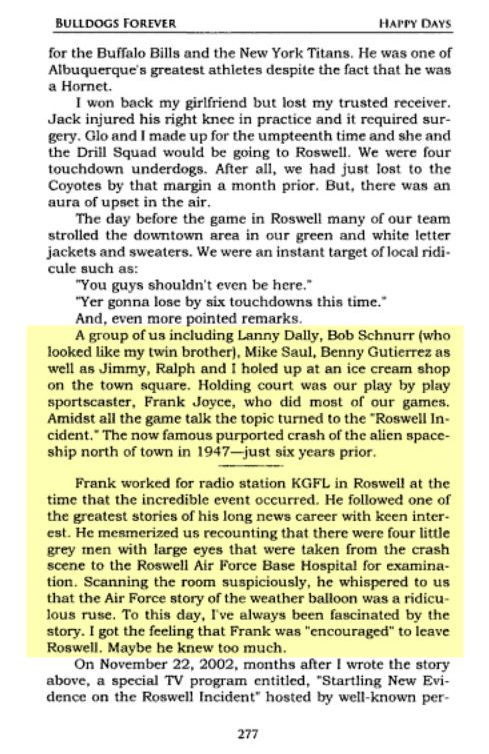
The day before the game in Roswell many of our team strolled the downtown area… A group
of us including Lanny Dally, Bob Schnurr, Mike Saul, Benny Gutierrez as well as Jimmy,
Ralph and I holed up at an ice cream shop on the town square. Holding court was our play by
play sportscaster, Frank Joyce, who did most of our games. Amidst all the game talk the
topic turned to the "Roswell Incident." The now famous purported crash of the alien spaceship
north of town in 1947—just six years prior.
Frank worked for radio station KGFL in Roswell at the time that the incredible event
occurred. He followed one of the greatest stories of his long news career with keen interest.
He mesmerized us recounting that there were four little grey men with large eyes that were
taken from the crash scene to the Roswell Air Force Base Hospital for examination.
Scanning the room suspiciously, he whispered to us that the Air Force story of the weather
balloon was a ridiculous ruse. To this day, I’ve always been fascinated by the story. I got the
feeling that Frank was “encouraged” to leave Roswell. Maybe he knew too much.
(Quist's memory that Joyce spoke of "four little grey men with large eyes" taken to the base hospital was never part of Joyce's later story of what happened. Quist may have been influenced by later books on the event.)
1954
Flying Saucers on the Attack (Harold Tom Wilkins), p. 71
Wilkins offered the following accurate summary of the Roswell incident, clearly taken directly from period newspaper accounts:
"Close to the place where the first atomic bomb was tested, a rancher in Roswell, New Mexico,
U.S.A. said, in July 1947, to have found a flying saucer. It landed on his ranch, and was
inspected by officers of the 509th atomic bomb group of the 8th U.S. Air Force, who sent it to
a ‘higher [head]quarter[s].’ This reported find followed a report from Dr. C. J. Zohn, guided
missile expert of the U.S. Naval Laboratory, that he and two other scientists had sighted a
flying saucer near White Sands, New Mexico, a proving ground to which public access is
prohibited. Down came U.S. Army authorities who declared this was merely a weather balloon;
despite the plain statement of Mr. Ivan R. Tannehill, weather bureau chief forecaster, that it
was unlikely that this mysterious object speeding through the skies at a speed above the rate of
transmission of sound waves, could have been a weather balloon. He pointed out that weather
balloons have been in use for many years."
Fall, 1953
H. L. Quist – 2004, p. 277
Although not published until 2004 after Roswell became well-known, this memoir by Quist recounts when the Albuquerque High School football time was in town in 1953 to play the heavily-favored Roswell team, and were told about the Roswell Incident by Frank Joyce, who later became a major Roswell witness. At the time of the incident, Joyce was a young disc jockey and radio announcer for KGFL radio in Roswell. Joyce said he had talked to the rancher Mack Brazel when he first came to town to report the crash to the Sheriff. Brazel told him about the large field of debris, and after pressing him, Brazel added that there were small,.smelly, nonhuman bodies. Later, after the Army grabbed Brazel, Brazel met with Joyce and told him he got the story wrong, he was forced to change his story, and Joyce would be wise to do the same. When Joyce said what about the little green men Brazel had previously told him about, Joyce claims Brazel responded that they weren't green, and left. Later Joyce moved to Albuquerque and became a well-known radio announcer there. As a United Press stringer, Joyce also put out the Roswell base press release that they had recovered a "flying disc". Joyce kept some of the originals of some of the UP telexes of July 8, 1947, indicating he did indeed attach great importance to what happened.
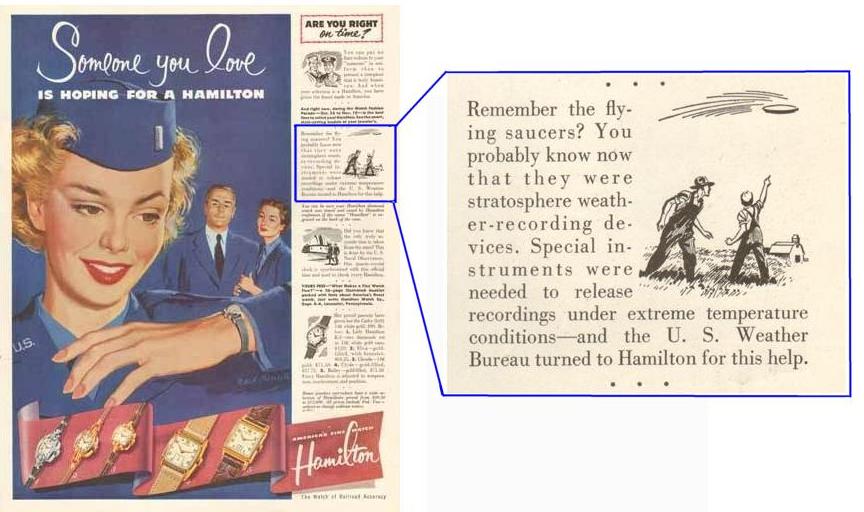
1951 Hamilton watch advertisement
Along with that stylish Hamilton watch for that special Air Force woman-in-blue you love was a strange factoid about how those flying saucers, pictured as seen by stereotypical country hicks, were allegedly explained by weather balloons. "Remember the flying saucers? You probably know now that they were stratospheric weather-recording devices." This ad is another indirect reference to the weather balloon explanation for Roswell 3-4 years before and the accompanying military weather balloon debunkery of all flying saucer reports that followed in the next few days. It was recently sold on eBay and mentioned over on the Ufomystic and Silver Screen Saucers blogs, from which I discovered this item.
Hamilton watches role in this? "Special instruments were needed to release recordings under extreme temperature conditions--and the U.S. Weather Bureau turned to Hamilton for this help." It wasn't just weather equipment. Hamilton had a history extending back to 1910 of large military contracts supplying watches for the troops. That was almost their entire business during WWII. If, hypothetically, they were asked to throw in a little anti-saucer ridicule into one of their ads, were they going to say "no" to Daddy? This might explain the ad, which is a bit weird on several levels. Copyright application for the "Hoping for a Hamilton" slogan dates to Sept. 19, 1951 and one such ad appeared in the Saturday Evening Post Sept. 22. It was also in 1951 that the military was again pushing the idea that ALL flying saucer reports were the result of misidentified sightings of large experimental balloons, such as the Skyhook. (See Mogul UFO reports) The Navy did this earlier in the year, and the Air Force took up the drumbeat in October.
July 11, 1957, Albuquerque Tribune, p. 18
IN DAYS OF YORE (In The Tribune)--Ten Years Ago
"An Alamogordo Army Air Field public relations man said a possible explanation of flying saucers is the number of balloons being released there..." This 10 year look-back item again references the saucer/Roswell balloon debunking demonstration that took place at Alamogordo July 9, 1947, the day after Roswell was debunked as a weather balloon, and was one of a number of such debunking demonstrations put on by the AAF and the Navy in the immediate aftermath of Roswell. For more details and photo, see 1948 New Mexico Magazine above, which references the same debunking demo.
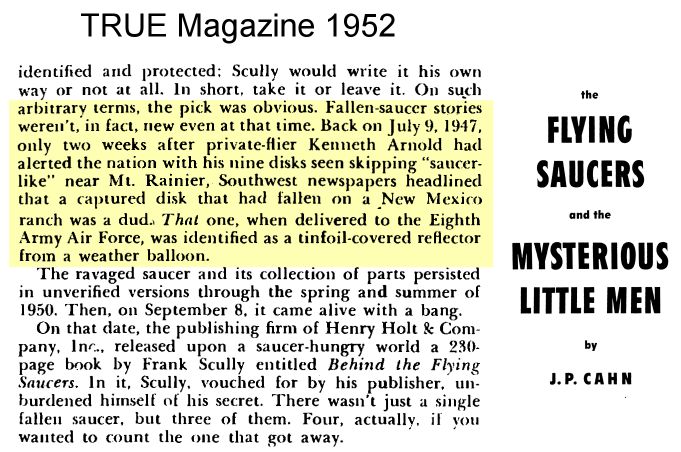
“The Flying Saucers and the Mysterious LIttle Men”,
by J. P. Cahn
This well-known debunking of Frank Scully and "Behind the Flying Saucers," particularly the alleged Aztec, N.M. saucer crash of 1948, contains a direct reference to Roswell, but not by name:
"Fallen-saucer stories weren't, in fact, new even at that time. Back
on July 9, 1947, only two weeks after private-flier Kenneth Arnold
had alerted the nation with his nine disks seen skipping "saucer-
like" near Mt. Rainier, Southwest newspapers headlined that
captured disk that had fallen on a New Mexico ranch was a dud.
That one, when delivered to the Eighth Army Air Force, was
identified as a tinfoil-covered reflector from a weather balloon."
A quibble with the accuracy is the statement that the story was confined to Southwest newspapers, when in fact it was nationwide and even international.
1949 and 1950
Frank Scully, Variety magazine articles and book “Behind the Flying Saucers”
Frank Scully was an author and Hollywood Variety magazine society columnist. He was the first person to write about crashed flying saucers and recovered alien bodies in a serious way. In October and November 1949, Scully published two columns in Variety, claiming that extraterrestrial beings were recovered from a flying saucer crash, based on what he said was reported to him by scientists involved. His Sept. 1950 book "Behind the Flying Saucers" expanded on this, adding there had been three such incidents in N.M and one in Arizona, including one that crashed near Aztec, N.M.
Although largely written off by most Ufologists as Scully being conned by two hoaxers (see Death Valley crash case immediately above, Leonard Stringfield comments below and 1952 TRUE magazine expose, which mentions the Roswell case), there is also speculation that maybe some of the material on crashed saucers and recovered alien bodies was in part inspired by Roswell. Very similar to Roswell, e.g., Scully wrote about the exterior shells of the saucers made of superhard, superstrong metal resembling aluminum that couldn’t be bent and couldn’t be cut through with diamond drills or acetylene torches. Inside was parchment-like material with hieroglyphics. One of the New Mexico saucers (the one near Aztec) allegedly landed (but didn’t crash) on a ranch.
However,there were also many differences from Roswell. All the recovered saucers were intact and larger than reported at Roswell. The aliens were basically small humans, with things like hair. So like Bernard Newman and his crashed saucer novel from two years before, similarities to Roswell, but also big differences. Prof. Robert Spencer Carr in 1974 would revive the Aztec crash, saying he had independent sources confirming that it had happened.
August 1949, Mojave Desert crash near Death Valley, CA
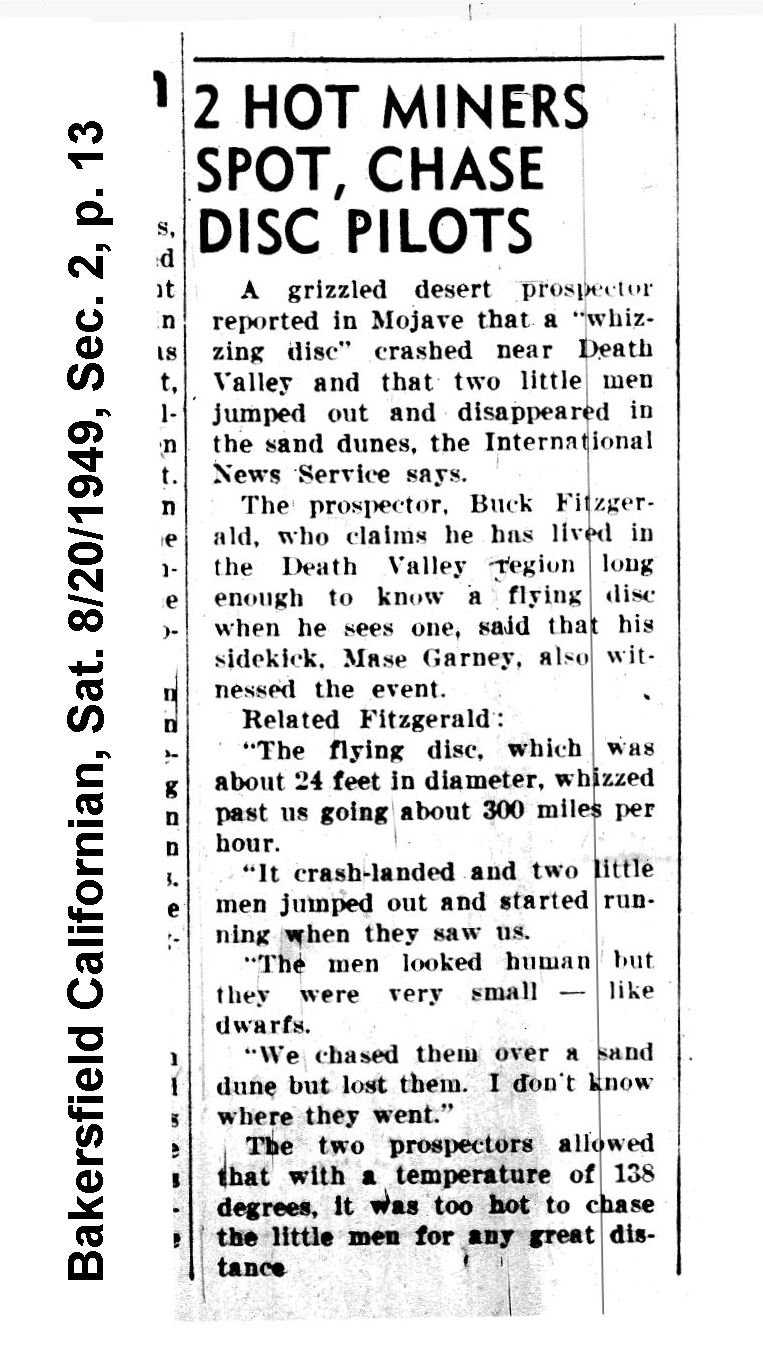
Bakersfield Californian, August 20, 1949, Section 2, p. 13
2 HOT MINERS SPOT, CHASE DISC PILOTS
San Francisco Examiner, August 20, 1949, p. 2
'Little Men' in Flying Disc
Not a direct reference to Roswell, but illustrates that stories of crashed saucers with tiny humanoids long predate the reopening of the Roswell case in1978 and the widely-known Frank Scully stories of crashed saucers and tiny alien bodies immediately below that first started coming out two months later. (Although, as we shall see, this story and Scully are almost certainly connected.)
Two "prospectors" (probably Scully's sources using aliases) claimed to have seen a 24-foot diameter disc crash in the desert near Death Valley, California and two small humanoids scamper away.
The incident is usually attributed as happening the day before the story came out on August 20, 1949, and also solely attributed to the Bakersfield Californian newspaper. But the actual article from the Californian (at right) gives no specific date and indicates this was an INS (International News Service) story, the wire service of the Hearst newspaper chain. I found the near-identical article in the Hearst newspaper San Francisco Examiner (at right).
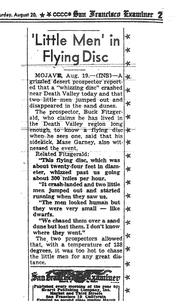
The Examiner added an August 19 and Mojave, CA dateline, suggesting the incident was first reported Aug. 19 in Mojave. Mojave is about 60 miles east of Bakersfield and 100 miles NE of Los Angeles. It also happened to be the "stomping grounds" of Scully's two sources, Silas Newton and Leo Gebauer, who were trying to sell investors on the idea of a huge oil field underlying the area.
Another common claim is that after the miners futilely chased the two small beings, they returned to the crash site but the disc was no longer there. But no such mention appears in the actual articles. (In fact, in an earlier FBI version below, they claimed to have closely examined the disc.) The text of the news article reads:
[S.F. Examiner: MOJAVE, Aug. 19.--(INS)--] A grizzled desert prospector reported that
a "whizzing disc" crashed near Death Valley today and that two little men jumped out
and disappeared in the sand dunes [Californian: , the International News Service said].
The prospector, Buck Fitzgerald, who claims he has lived in the Death Valley region
long enough to know a flying disc when he sees one, said that his sidekick, Mase Carney,
also witnessed the event.
Related Fitzgerald: "This flying disc, which was about twenty-four [24] feet in diameter,
whizzed past us going about 300 miles per hour. It crash-landed and two little men jumped
out and started running when they saw us. The men looked human but they were very small
--like dwarfs. We chased them over a sand dune but lost them. I don't know where they went."
The two prospectors allowed that with a temperature of 138 degrees, it was too hot to
chase the little men for any great distance.
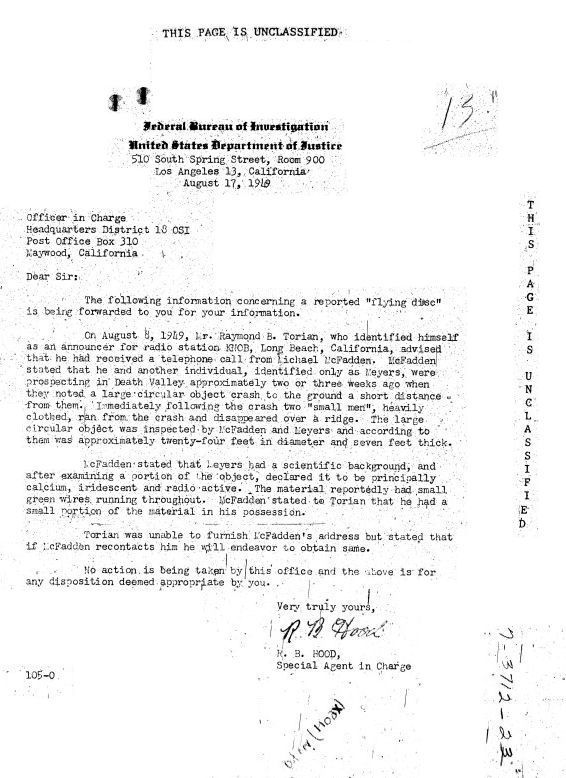
The plot thickens when we throw in a letter in Project Blue Book files where an FBI agent wrote Air Force OSI [counterintelligence] on August 17 (document at right) about being contacted by a Long Beach radio announcer. The announcer told him he had been called August 7 by a man calling himself "Michael McFadden". "McFadden" told the same basic but more elaborate story of he and his friend "Meyers" prospecting in Death Valley 2 or 3 weeks before and seeing a 24-foot diameter, 7-foot thick circular disc crash nearby, 2 "small men", now "heavily clothed", ran from the disc and disappeared over a ridge. "Meyers" had a "scientific background" and examined the disc, "declared it to be principally calcium, iridescent and radio active. The material reportedly had small green wires running throughout." "McFadden" claimed he had a sample of the material. (Just as Silas Newton with Scully said he had metal samples of a New Mexico crashed disc. Newton was probably "McFadden", then "Buck Fitzgerald" when he later called the newspapers, while Leo Gebauer was "Meyers" and then "Mase Carney".)
The Air Force got this right (whether they investigated or not), quickly labeling it "another hoax." The question remains where Newton/Gebauer got the idea of crashed saucers manned by small humanoids: vivid imagination or based on rumors they had heard? (See comments in Frank Scully item below)
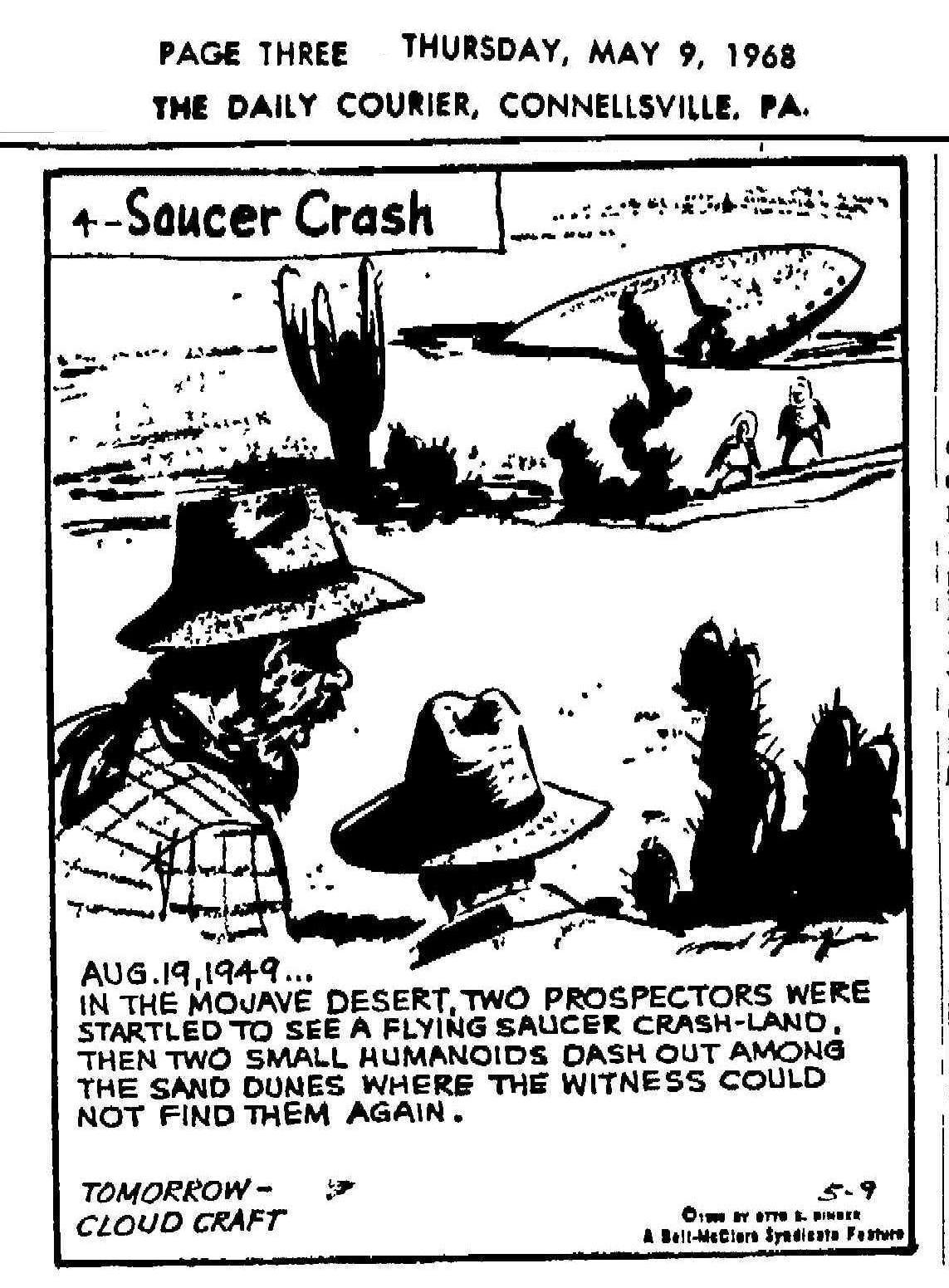
Connellsville (PA) Daily Courier May 9, 1968, p. 3
(Source of cartoon at right)
The cartoon at right illustrates the story was still publicly circulating 19 years later. It reads, "Aug. 19, 1949. In the Mojave Desert, two prospectors were startled to see a flying saucer crash-land, then two small humanoids dash out among the sand dunes where the witness[es] could not find them again."
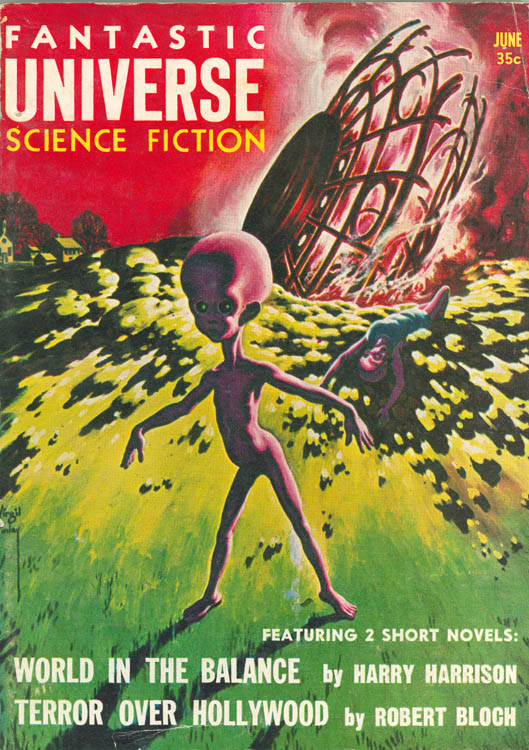
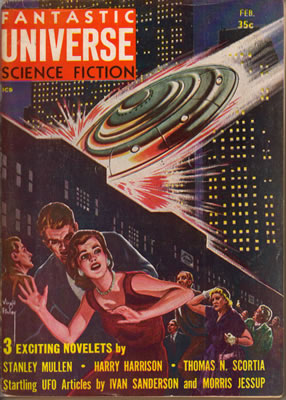
Fantastic Universe, June 1957 & Feb. 1958
Two example covers from a 1950s Sci-Fi magazine depicting crashed saucers. The June 1957 one is especially interesting, with its rural setting and now-stereotypical small, pale alien with large head and slender body, very similar to contempory descriptions of the Roswell bodies (the "Grays"). The artist was the well-known Sci-Fi illustrator Virgil Finlay. Where he got the idea for the "Roswell-like" alien from the crashed saucer or whether he knew anything at all about Roswell is anybody's guess. But obviously the rumors of crashed saucers with little humanoid bodies continued to circulate.
(Added May, 2026)
Oct. 15, 1954
French Magazine, L'Alsace Illustrée
Patrick Gross recently added this item to his extensive UFO website. If nothing else, it illustrates that rumors about Roswell were not confined to the U.S., but occasionally made it into foreign publications. Gross' translation:
What if the Martians were Russians?
The "saucers" exist
But all hypotheses are allowed concerning the origin of the famous craft
"...Here is what "Paris-Match" stated in its October 2 issue: "America has a slightly older experience with aviators of the unknown. As early as July 1947, in the New Mexico desert, the 8th Air Army recovered a flying saucer 30 meters in diameter containing the half-charred bodies of sixteen human-shaped creatures, dressed in blue uniforms and measuring about 1 meter. These corpses are preserved in alcohol jars in a secret laboratory in Chicago.""
This is a conflation of the 1947 Roswell and 1948 Aztec NM UFO crash stories. "July 1947" and "8th Air Army" would refer to Roswell, but the "30 meters", "sixeen human-shaped" and "half-charred bodies" are from the Aztec story. Apparently this story first appeared in "Paris-Match", which was a weekly, high-end French news and photo-journalism magazine, similar to the American LIFE Magazine. There was a massive UFO wave in Europe at this time, particularly in France, which peaked in October 1954, and probably accounts for the articles being published and the subject matter being taken seriously. Gross did an extensive compilation of these 1954 UFO reports. Three weeks after publishing the Roswell mention, on October 23 Paris-Match also published a letter about an alleged 1921 alien abduction.
(Added July 2026)
1948-1949, Summary of June/July 1947 flying saucer reports, including Roswell
(Found in search of newspapers.com using keywords "flying saucer AND Roswell"
The first 2 years after Roswell, these news articles and an editorial explicitly mentioned Roswell. In the body of the articles, historical context is provided by recounting the major reports of June/July 1947, starting with pilot Kenneth Arnold's famous sighting of June 24, 1947 near Mt. Rainier, ending with Roswell, which, of course, was nothing but a stupid weather balloon.
Fresno (CA) Bee, July 5, 1948, p. 5
Northwest Fetes Fourth, But Minus Those Flying Saucers
Sacramento (CA) Bee, July 5, 1948, p. 1
Pacific Northwest Observes Fourth Minus Flying Saucers
Stockton (CA) Daily Evening Record, July 5, 1948, p. 1
It Was Just a Year Ago That 'Flying Saucers' Made Debut in Northwest
Muncie (IN) Evening Press, July 5, 1948 p. 10
Northwest Happy Over Absence of Those Discs
Rockford (IL) Register, July 5, 1948, p. 1
Northwest Has Dull July 4th This Year Without Flying Discs
By Harold Paterson
Portland, Ore., July 5--(INS)--The Pacific northwest celebrated its Fourth of July minus the flashes of those flying discs this year. Just a year ago this week, a pilot [Kenneth Arnold] flying from Boise, Idaho, reported he saw the first set of nine saucers skimming over the mountains of Washington... A year ago today, the experienced crew of a United air liner said it had followed five discs over Boise, Idaho, for 45 minutes...
Army air force officers in New Mexico announced a disc had been found on a ranch near Roswell and were rebuked by superiors next day when it turned out to be a weather balloon.
The Fourth air force officially dropped its search on Aug. 9 but five months later a Kentucky national guard airman was killed chasing down a "flying disc..." [the Thomas Mantell case]
The Louisville Times, April 29, 1949, p. 10 (editorial)
Wells and Verne Would Have An Answer
"...says the intelligence division at WRIGHT-PATTERSON Field, Ohio: 'The saucers are not a joke. Many of the incidents already have answer--meteors, balloons, falling stars, birds in flight, testing devices, etc. Some of them still end in question marks.'
"The flying disk, saucer, falling bird, reflection, meteor, spot before the eyes or whatever it was, first was reported on Jun 25 [sic], 1947, when a Boise, Ida., businessman [Kenneth Arnold] said he caught sight of nine objects that seemed to be moving about 1,200 miles an hour. Within a week flying disks had been seen--or reportedly seen--in 10 states. The business of seeking saucers took on national prominence after the crew of a United Air Lines plane flying from Boise to Seattle reported viewing nine objects which were 'definitely neither aircraft nor smoke, nor a cloud.'
"The new national pastime suffered an awful shock on July 9 [sic] when an air force officer at Roswell, N.M. issued a statement that the flying disk had become a reality with discovery of something of that sort on a ranch near Roswell. That statement was discussed on the radio and in newspapers for seven hours before the object finally arrived at Fort Worth, where it had been sent for study. And what was it? It was the radar target of a weather balloon, about 100 of which are sent up daily.
"This announcement put a slow leak in the bubble. But it didn't end the speculation completely. On January 8 ast year three Kentucky National Air Guard officers chased some aerial object over the state. One of them, Capt. THOMAS F. MANTELL, JR., Louisville, apparently blacked out at about 30,000 feet and fell to his death. A fellow officer said the object looked like a star..."
Baltimore Sun, Aug. 21, 1949, p. 1
On Glen Burnie 'Flying Saucers'
Says 2 Experimental Craft Have Absolutely No Connection With "Reported Phenomenon"
By HOWARD NORTON [Washington Bureau of The Sun]
"Washington, Aug. 20--The story of the flying saucers appeared tonight to be as confused as ever, despite he discovery of two saucer-like aircraft models in a Glen Burnie barn. The Air Force today flatly contradicted a statement made by one of its apparently informed officers yesterday that the Glen Burnie discoveries were 'definitely' prototypes of the flying saucer.
Official Spokesman Comments
"Tacitly admitting that the Air Force doesn't have a flying saucer to judge by, and probably hasn't even seen one, an official spokesman of the Air Force nevertheless issued this blunt comment:
"'The Air Force states that the two experimental aircraft found near Baltimore, Md., yesterday have absolutely no connection with the reported phenomenon of flying saucers.'
"Pressed for more details, the spokesman added that the office of the director of intelligence at Air Force headquarters had authorized him to say, concerning the Glen Burnie aircraft, that:
"'Neither its configuration nor its reported characteristics of flight would qualify it to be related to the reports of flying saucers...'
....Apparently is Second One
"This was apparently the second discovery reported by official quarters of 'flying saucers' in the last two years. The first, on July 8, 1947, was reported by an army public relations officer at Roswell, New Mexico. But a short time after the officer's announcement of the find, army weather officers said that object found was not a flying saucer. They said it was a standard weather balloon, known as a "ray wind target" and used to determine the direction and velocity of the winds at high altitudes. When rigged up, it was explained, the balloon looked like a metallic, six-pointed star."
Disk Stilll Mystery, Says Original Observer
"The man who first reported incredible undulating disks flashing through the air doubts the objects found on a Maryland farm will help to explain the 'flying saucer' mystery.
"Still mystified, he said yesterday the 'saucers' might come 'from anywhere.'
"Kenneth Arnold, Idaho flyer, who reported sighting nine shiny disks flipping over Mount Rainier in June 1947, declared that Jonathan Caldwell's roto-plane 'saucer' 'is a gadget that's not particularly new.
"'I know inventors who've experimented with the same thing since 1932 and say they have no way to get the kind of performance the flying disks do.'
"Arnold, who claims to have photographed two disks in flight, describes the craft he has seen as 'quarter-moon shaped, moving at more than 1,200 miles an hour with a peculiar fluttering motion and reflecting a blue-white glow from the center.
"'Saucers' which he has sighted on four occasions, he said, are 'definitely of metal material and definitely some type of aircraft which is unconcerned with pilots in other planes.'"
Dec. 20, 1947
Sydney New South Wales Daily Telegraph, p. 17
This Australian paper, in its yearly review of top 10 news story categories, placed the new flying saucer phenomena into the "Freak" category, with Roswell being very briefly mentioned, but not by name.
NEWS YEAR: 10 big stories of 1947 reviewed
FREAK
Saucers in the sky
"In June-July the Flying Saucer scare rattled America and the world.... A saucer down in New Mexico proved to be a weather balloon."
