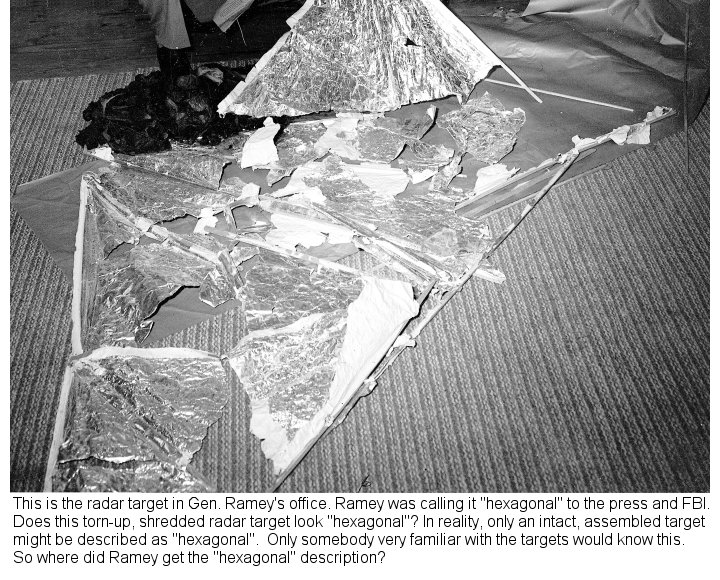
General Ramey on July 8, 1947, was describing the Roswell crash object as "hexagonal" and also saying that he thought it might be a weather radar target. The problem is the radar targets did not normally appear "hexagonal". They might only appear hexagonal if intact and fully assembled and when viewed from restricted angles. But all Ramey had was a badly broken and torn-up radar target in his office spread out on his floor. How could he deduce any possible hexagonal shape from this? Does the ripped up target pictured below at Ramey's feet resemble anything "hexagonal?
The thesis examined here is that Ramey couldn't possibly have come up with this description on his own and it had to be provided for him ahead of time, probably by military intelligence or counterintelligence, as part of an orchestrated weather balloon debunkery campaign of the Roswell incident. Possibly the alleged Roswell radar target was being called "hexagonal" to make it seem more disc-like, part of the strategy to sell the public on the explanation.

Gen. Ramey's impossible "hexagonal" description
An addition to "boxlike", looking at these photos of intact targets, some might also be described as "squarish", which isn't surprising, because these radar kites were built around a cubic core, and the foil-paper panels across the balsa struts were themselves square or triangular, as illustrated on my radar target construction page. So where does "hexagonal" come from?
The central framework of these targets when assembled was balsa wood sticks crossing at right angles. These can also be pictured as the diagonals of a cube. If you look directly at the corner of a cube and ignore the 3-dimensional structure, you might describe the profile of the cube as "hexagonal", but this is a very restricted vantage point. Ordinarily, few people would ever describe the shape of a cube as "hexagonal" and would instead describe it as squarish or maybe "box-like". They would never use a quirky hexagonal description if the cube was made of paper, torn up, and then spread out on the floor, like the case of Ramey's target. How do you deduce any sort of hexagonal or other shape from this?
The radar targets were not cubes, but they were built around the same cubic core. Again, if the targets are assembled and intact and you look at them from very restricted vantage points, namely directly above or below, and again ignore the 3D structure, they might be described as having a hexagonal shape.
This is illustrated in the graphic below:
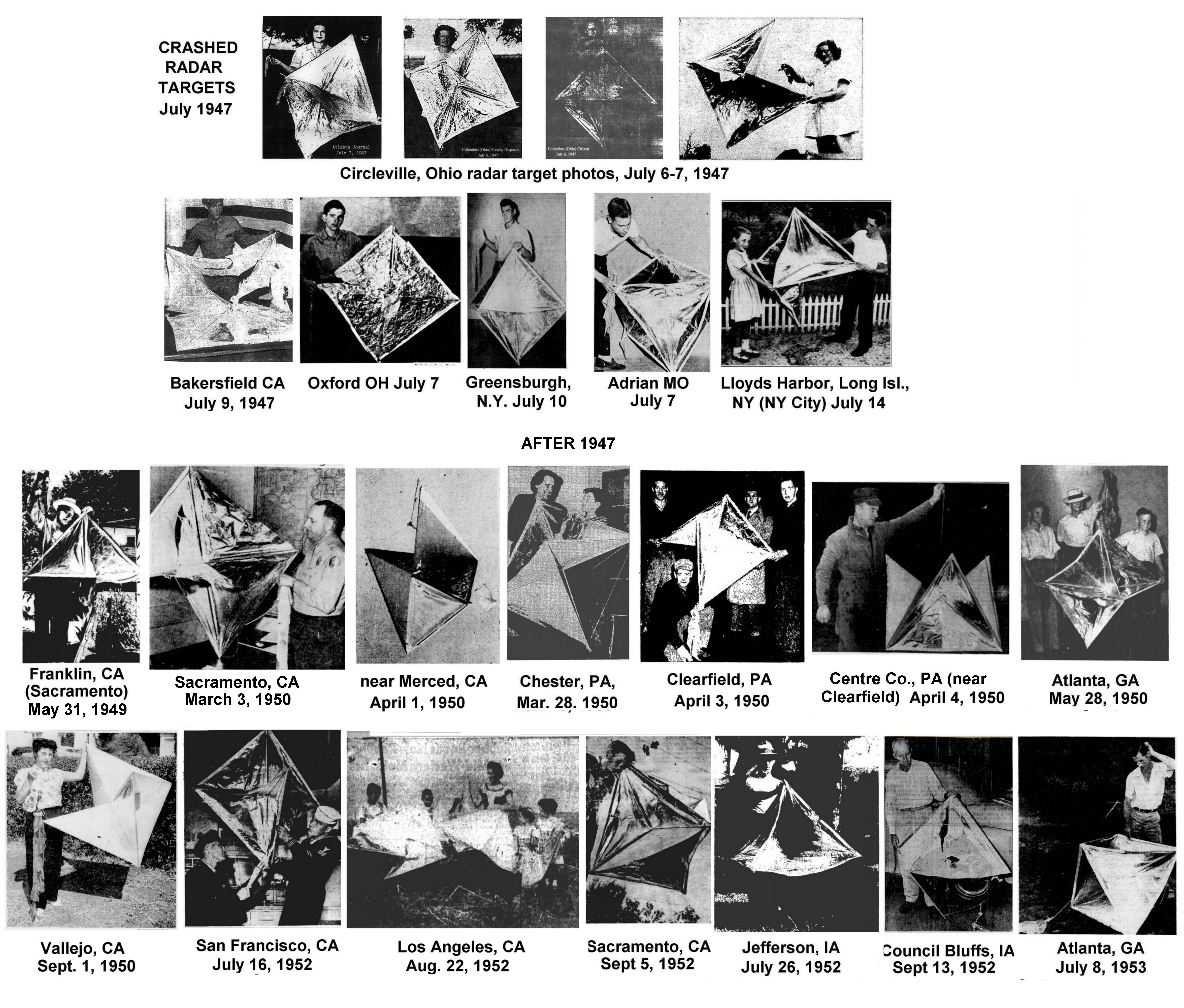
Directly below are photos from newspapers at the same time illustrating radar target crashes taking place elsewhere in the country. (2026: 14 additional examples have been added from the a few years later and 2 examples from July 1947.) The Circleville, Ohio target crash may be particularly relevant, since it preceded Roswell, was widely reported with photos (including down in Fort Worth where Ramey was), and already was being used as a possible explanation for all the flying disc reports. Military intelligence/counterintelligence may very well have taken note.
Soon after Ramey's debunking of Roswell with the weather balloon, military intelligence at the Pentagon was telling at least one reporter they thought the radar targets explained the saucers, and military demonstrations of the radar targets took place in succeeding days to re-emphasize this point. United Press and Reuters explicitly reported that the military was running a debunking campaign to stop all the flying saucer rumors. (see essay How the military debunked the saucers after Roswell)
Unlike Ramey's badly broken, shredded target, ALL these crashed targets pictured below are relatively intact, the vast majority seemingly in perfect shape, which is itself odd. Only two or three have the foil partly torn (Bakersfield, 1947; Council Bluffs 1952; maybe Sacramento 1950). How did Ramey's target get so smashed and torn apart? (Maybe because they took it out of a box and tore it up with their bare hands to make it look like a crashed object?)
To be fair, the Council Bluffs story stated the object was "heavily damaged" when it hit the ground, but also noted that "a considerable portion ... is still intact." The photo itself, however, shows little damage with the target still very recognizable. The 1952 Los Angeles crash story hinted the object may have been damaged and in multiple pieces (they tried to reassemble it), but the photo is of very poor quality. It might instead be 2 targets sent up together with the finders (a mother and small children) not knowing what a normal radar target looked like. It certainly does not seem to show a totally broken up and shredded target like Ramey's. There was also another crashed radar target story (no photo) where the finder said the object was being driven hard by the wind when it came down and several of the sticks did break. Again, I doubt a few broken sticks would look remotely as torn-up and broken as Ramey's target. Finally, a flurry of targets were found in central Pennsylvania in March/April 1950. The 3 examples with photos seem to show intact, undamaged targets. But one not photographed was reported found in a tree with pieces on the ground. It was said to be "broken beyond repair." So occasionally there was some breakage and tearing, but generally these targets came down undamaged and fully intact. None of those pictured below remotely resemble what Ramey displayed.
.
Notice also that these other crashed, intact targets do not look "hexagonal". (The sole exception might be the Adrian, MO photo which has a distorted, somewhat hexagonal profile, but still obviously a 3-D object, not a flat disc or hexagon. It was instead described as "box-like.") The farmer who found the Circleville target said, "The star-shaped object had six points." Another Circleville target crashed a few days later. The two targets were described in one newspaper as "two queer six-point foil-covered box-like contraptions." The one found in Oxford, OH, was described as "triangular." Sometimes diamond-shaped, squarish, 4-sided, rectangular, pyramidal, or star-like was used. But these descriptions were based on mostly intact targets, not a badly broken, torn-up one.
Out of several dozen radar target recoveries I have found from 1947-1953, there was only one example from a "non-Ramey" source where the target was described as "hexagonal". This was in late August, 1947, in rural Missouri near Kansas City. The object was said to be "something like a huge hexagon or box kite and attached to it is the remnant of a rubber balloon." A detailed description was given of its many reflecting services (19) and four fins, suggesting this target, like most of the others pictured below, was intact and undamaged. Thus, again, quite unlike Ramey's badly shredded object from which it would be impossible to deduce a "hexagonal" shape.
But, again, only a specialist very familiar with the targets might know they could appear hexagonal. E.g., if you routinely launched the targets from weather balloons and looked at them ascending from below, you might notice the hexagonal profile. As they rose high enough, they would also lose depth cues that otherwise destroy the hexagonal appearance. But Ramey wasn't in this situation. All he had was a badly torn-up target spread out on his floor.
Unless Ramey was a virtual weather expert and thus might know about a possible "hexagonal" shape, he had to have been provided the description from someone else ahead of time, probably by Army intelligence or counter-intelligence. This alone virtually proves that the radar target "explanation" was predetermined and prescripted., i.e. it was part of a coverup operation. (It has also been noted that Ramey was the only one photographed that day in full dress uniform instead of a casual daily work uniform like Col. Dubose, pictured next to him, again suggesting this photo-op was all a pre-planned operation. Similarly Roswell intelligence officer, Marcel, and Ramey's weather officer, Newton, were also photographed in regular military work uniforms.)
As described in more detail immediately below, Ramey was telling the press at times he thought he was maybe dealing with a radar target but wasn't sure. He would later bring in a weather officer for positive identification. But why mess around around with a weather officer and pretend you aren't sure, if you are also knowledgeable enough about what you have to provide a "hexagonal" description? Either Ramey was a weather balloon whiz or he wasn't.
Ramey was telling United Press and others (such as the San Francisco Examiner) that he thought he had a radar target on his hands, but he hadn't let anybody see or photograph yet because of the security imposed from Washington. In other words, Ramey was claiming he hadn't consulted with any of his men yet because of security. (This also fixes the time of Ramey's statement to before when the press photos were taken.)
In contrast, Reuters news agency reported one of Ramey's intelligence officers (also said to be the "duty officer" or Ramey's official representative during the PR crisis), Major Edwin M. Kirton (also cited below) quoted Ramey as saying
"It looks like a hexagonal object covered in tinfoil.... It is possibly a weather balloon flown at the highest altitude but none of the army men at this base recognize it as an
army type balloon."
Notice the contradictions here. To UP, Ramey says nobody else had seen the debris because of security, but he thought it a radar target from a weather balloon. But to Reuters, he is claiming consultation with others at the base, but still nobody recognized it for what it was, though "possibly" from a weather balloon.
Further the radar targets were developed by the Army during WWII; they were "an army type balloon". How can you recognize the object as a radar target (as Ramey told UP and others) and further provide a "hexagonal" shape to Reuters, yet nobody at the base could recognize it as an Army type balloon? You had to know exactly what it was to come up with either the radar target ID or the "hexagonal" description.
Intel officer Kirton was also soon talking with the Dallas FBI office and repeating the Reuters' "hexagonal" shape description, but this time being more definitive about the balloon/radar target identity. The FBI summed up their inquiry in a later 5:17 p.m. (CST) telegram to Washington. (Unknown by the FBI when they sent the telegram, Ramey would soon bring in his weather officer to make the definitive ID, as if there were any doubt, and this was announced at 6:30 by AP.) The relevant section of the telegram read:
THE DISC IS HEXAGONAL IN SHAPE AND WAS SUSPENDED FROM A BALLON [sic]
BY CABLE, WHICH BALLON [sic] WAS APPROXIMATELY TWENTY FEET IN DIAMETER.
FURTHER ADVISED THAT THE OBJECT FOUND RESEMBLES A HIGH ALTITUDE
WEATHER BALLOON WITH A RADAR REFLECTOR, BUT THAT TELEPHONIC
CONVERSATION BETWEEN THEIR OFFICE AND WRIGHT FIELD HAD NOT BORNE
OUT THIS BELIEF. DISC AND BALLOON BEING TRANSPORTED TO WRIGHT FIELD
BY SPECIAL PLANE FOR EXAMINATION.
According to this, after having some sort of debris described to them by phone, the technical whizzes at Wright Field weren't buying Ramey's balloon/target story, a very interesting admission to the FBI that the public never heard. But if the debris had been a simple balloon and balsa wood/foil radar target, Wright Field experts should have had no problem immediately recognizing it for what it was. Perhaps the military felt they had to tell the FBI this to justify the flight that did go on to Wright Field. (The telegram goes on to say that the Cincinnati FBI office was to be informed of what Wright Field discovered, but a search of files by the GAO in 1994 during their Roswell inquiry failed to find any documents indicating the FBI was further informed of anything regarding Roswell. See FBI Roswell telegram.)
When Ramey finally brought in the weather officer (soon after the radar target at top was photographed), he of course immediately IDed the radar target and was quoted by AP saying they looked like a "six-pointed star." Major Kirton, who previously gave Reuters and the FBI Ramey's "hexagonal" shape description for the "disc", then quickly spoke to the Dallas Morning News at 5:30 p.m. (CST) giving the definitive radar target ID, including its name (Rawin), and the weather officer's six-pointed description.
"It is a Rawin high altitude sounding device," Major Kirton said. He described such an
instrument, when undamaged, as of a design resembling a six-pointed star."
Yes, it might resemble a six-pointed star "when undamaged", but how about when heavily damaged? Again why would Ramey earlier use a "hexagonal" description for a torn-up target?
Below is another photo illustrating preparations for a Mogul balloon launch in 1948. Again, viewed from the bottom and ignoring the 3D structure, the targets being attached to the balloon might be described as "hexagonal".
(Occasionally the Mogul balloons carried the targets for tracking. In the present, the Air Force claims it was an undocumented, large Mogul crash that was responsible for the radar target and balloon in Ramey's office and the Roswell debris, though there is far too little debris for this in the Ramey photos, which depicts only one balloon and target and which were always described as a singular weather balloon and target by Ramey and his men.).
Army Air Force officials here were as flabbergasted as the rest of the world. But under the personal direction of Lieut. Gen. Hoyt Vandenberg, acting AAF chief, who dropped into the Washington AAF public information headquarters in the midst of the excitement, they burned up the wires to Texas and New Mexico. . .
They got from Brig. Gen. Roger Ramey, Eighth Air Force Commander, a description of the object. It was "of very flimsy construction--almost like a box-kite", made of wood and with a cover "like tinfoil". . .
Ramey said he hadn't actually seen it himself as yet. He went to take a look, and called back that it was about 25 feet in diameter. He said he was shipping it on to Wright Field, Ohio, but would have one of the meteorological officers look at it first. . . .
We know from Gen. Vandenberg's daily log that he left his office about 50 minutes after the story broke on the AP newswire. So Ramey's quoted remarks after being called by Vandenberg date to about 1 hour after. Ramey at this time is quoted saying "he hadn't actually seen it himself yet", yet without seeing it is also calling it a "box-kite" made of wood and tinfoil.
But the really bizarre thing is the size description. After claiming to have gone to his office to finally have a look at the "box-kite", Ramey then claims it was "about 25 feet in diameter." The real targets were only about 4 feet across. Looking at the Ramey radar target photo at the top, it is quite clear that nobody in their right mind looking at this small quantity of debris could come up with a 25 foot size description. (For scale, the prominent long stick at the bottom slanted up to the right is only about 4 feet long.) This alone is a very good indication that there still was nothing in Ramey's office to look at.
This impossible 25 foot size wasn't a simple misprint in the Washington Post, because it continued to be repeated in other news stories, but now attributed to Pentagon sources instead of Ramey (another contradiction in the official story). For example, here is the ABC News radio report:
"In the meantime, General Ramey described the object as being of flimsy construction, almost like a box kite. He says that it was so battered that he was unable to determine whether it had a disc form, and he does not indicate its size. Ramey says that so far as can be determined, no one saw the object in the air, and he describes it as being made of some sort of tinfoil. Other army officials say that further information indicates that the object had a diameter of about twenty to twenty-five feet..."
Another interesting thing here is Ramey saying he was unable to determine whether the object had a "disc form" because it was "so battered". Exactly! If it was "so battered" how was he elsewhere able to determine it was "hexagonal" in shape? Or a "box kite"? Or a radar target? Or "25 feet in diameter"? Again Ramey and the military's story was all over the place.
At around 4:30 p.m. (CST) when Ramey began putting out these stories, he was apparently improvising and stalling until the flight arrived from Roswell with the real debris (around 4:45- 5:00), and perhaps still waiting for his men to procure a shill weather balloon and broken radar target for the photos that were taken around 5:15-5:30 (CST). Somewhere around 5:30, the weather officer came in, and the weather balloon/radar target story became a "done deal", first reported by AP at 6:30.


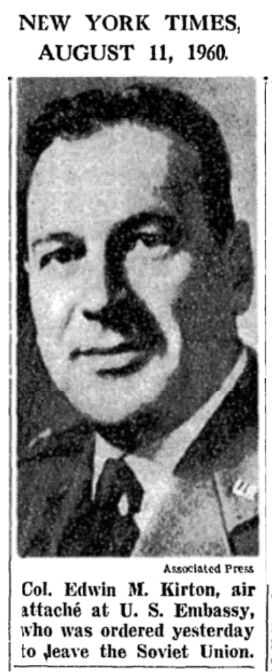
(Major Kirton in 1960, now Col. Kirton, a U.S. embassy air attache, was thrown out of Russia as a spy, so he may have been more than an ordinary intelligence officer, maybe really counterintelligence or something else.)
There are more contradictions in Ramey's story. Most news stories had Ramey early on also describing the device as resembling a "box-kite". E.g., another Reuters news story states, "In a telephone conversation with Army Air Force Headquarters in Washington he described the object as a "flimsy construction almost like a box."
So was it "hexagonal" or "almost like a box"? Ramey's all over the place.
There was probably a reason for this. Reconstruction of what happened from news stories indicates Ramey was providing his various descriptions before the debris had even arrived at Fort Worth from Roswell. Ramey was improvising and stalling.
The radar target photo in Ramey's office at the top was taken about 2 hours after the story first broke. But stories indicate that Ramey first began talking to reporters about 1 hour after (e.g., San Francisco Examiner story) and providing his radar target/balloon ID, and similarly was officially talking to the Pentagon about 1 hour after. This Washington Post story from their Pentagon correspondent is very telling: