1947 Weather Balloon Use
Introduction
Contemporary Roswell debunkers claim the foil/balsa kite radar target shown in 1947 Roswell crash debunking photos, allegedly the "real" recovered Roswell debris, came from a Project Mogul balloon. To bolster this claim, they further assert such radar targets were extremely rare in 1947 and used only on special project like Mogul. But the historical record actually shows that the military, in debunking Roswell and the many flying saucer reports, was claiming exactly the opposite, namely recent, routine, widespread use of the targets by both military and civilian weather services, and these targets, plus other weather balloon flights, supposedly explained the sudden widespread sightings of "flying saucers".
Obviously, both assertrions can't be true. So what are the historical FACTS? Here we examines actual documented weather balloon and radar target use back in 1947 and give sample quotes of widespread radar target use put out in the nation's press.
1947 General Weather Balloon Use -- Map
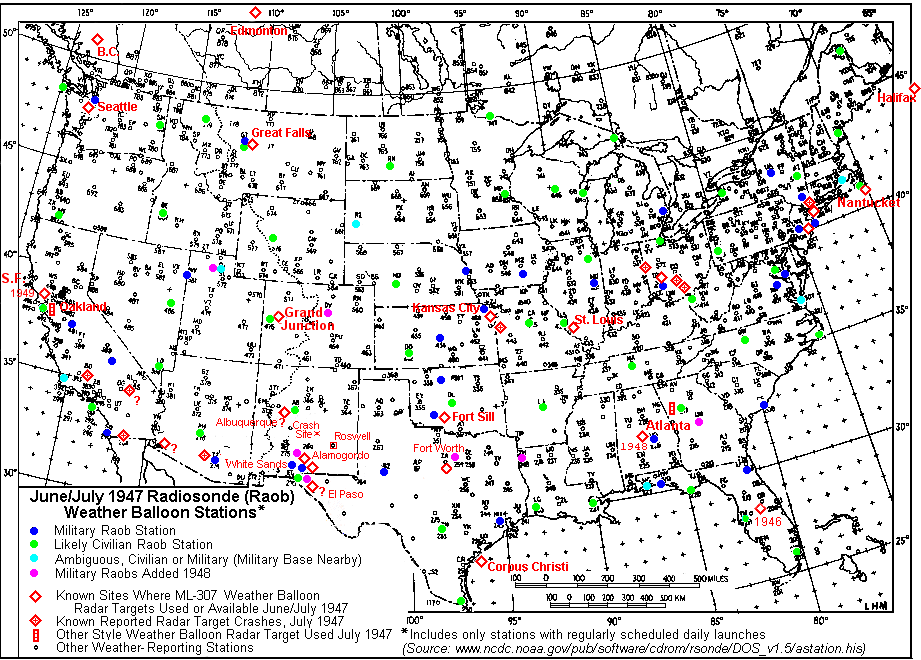
Below is a USA map (adapted from maps used by the Mogul project in their records) showing the distribution of continental USA weather balloon stations back in 1947/48. Each small black circle represents a weather station. Besides recording basics like temperature, humidity, etc., many of these stations also sent up several small pilot or pibal balloons to determine wind direction and speed at altitudes other than ground level. The balloons came in a variety of colors for better visual tracking and hundreds were sent up every day all over the nation.
Each large colored circle represents a radiosonde (radio sounding) weather balloon launch station. There was a network of 84 such stations in July 1947. Each of these stations sent up at least two radiosonde balloons daily. Thus, there were at least 168 such balloons sent up every day.
The radiosondes usually consisting of a larger weather balloon, the radiosonde instrument package, and a red crepe-paper parachute used for lowering the radiosonde for possible reuse once the balloon popped or deflated.
(Photo of a raob at launch with red parachute) The radio transmitter sent back weather information such as temperature, pressure, and humidity from much higher altitudes and also served as a beacon to permit directional tracking. Speeds and directions of winds in the upper atmosphere could thus be determined.
Data for plotting the radiosonde stations originally came from a list of these stations on the the NOAA Website (National Oceanic and Atmospheric Administration). The original link, however, is now defunk.
Military raob stations are marked in dark blue. Civilian stations are marked in green. Where a determination couldn't be made (station was located near a military base but not designated as such), the station has been marked with aqua. Military raob stations added in 1948 are marked with lavender.
Superimposed on this map are locations of newspaper reported radar target crashes during early July 1947 (red diamond with a cross). Locations where radar targets (RAWINS) can be documented as being used or demonstrated in early July 1947 are marked as an open red diamond (for the Mogul style ML-307 radar target) or with a red rectangle, for a long rectangular style target also in use (ML-306). Crash or use sites with a question mark are suggested but uncertain, based on newspaper stories. A RAWIN target station at Montgomery, AL mentioned in a UFO debunking article from 1948 is also marked as well as RAWINs used near Orlando, FL in 1946 as part of a thunderstorm research project. (Florida RAWIN launch photo)
Radar Target Use
The extent of a corresponding radar target network from this period is currently not known, but the targets were certainly used by both the Army and civilian meteorological services, although not as frequently as the radiosondes, probably because of limited radar facilities. In one story, the Roswell civilian meteorologist indicated that a great deal of military radar equipment, including radar reflectors, had been given to the U.S. Weather Bureau at the end of the war. On July 20, 1947, highy respected AP science writer Howard Blakeslee claimed about 100 radar targets were sent up every day. Similarly a 1949 UFO debunking article in the Saturday Evening Post stated that "thousands" of surplus Army radar targets had been turned over to Weather Bureau stations all over the country supposedly just when people started reporting flying saucers in 1947. (quotes)
One indication of the number of military weather stations that utilized radar for forecasting comes from a June,1948, Air Force letter. It states that the existing rawinsonde (radar wind target) net was soon to be expanded by 12 stations (but doesn't state the current number of stations). In addition, there were 32 installed precipitation weather radar units around the country with plans to install 22 more. This letter, classified SECRET, was from Headquarters 59th Weather Wing at Tinker AFB in Oklahoma City to Project SIGN at Wright-Patterson AFB. SIGN, then the official USAF UFO inquiry, had written asking if weather radar might be adapted to form a radar net to search for UFOs, which in retrospect is rather ironic. [Click here to view letter]
In addition to the weather services, military artillery units also used the targets during exercises to chart upper air currents. (This was first pointed out to me by Jan Aldrich, who had several years of military meteorological experience, and who currently heads up Project 1947). An example of this may have occurred down in the southern California and southern Arizona region. Three or four radar target crashes were reported (see chart). The one that crashed near the Mexican border in Brawley, CA, brought forth the statement from the local El Centro Naval station that it may have come from Yuma, Arizona. As it turns out, the Army was holding massive summer desert exercises there at the time, so Yuma is marked on the chart as a possible radar target source.
Military Claims Widespread Radar Target Use
Generally speaking, in July 1947 the military (through the nation's press) was claiming that the radar targets were in widespread use and also accounted for the nationwide flying saucer epidemic. Here are some sample quotes:
"It [Fort Worth object] was part of a box-kite type or weather balloon used by United States Weather Bureau and Army meteorological stations all over the country."
- Fort Worth AAF weather officer, Irving Newton, July 8, 1947: "Newton, who made the examination [of the debris photographed in Gen. Ramey's office], said some 80 weather stations in the U.S. were using that type of balloon and that it could have come from any of them." [main Associated Press Roswell story, July 9, many newspapers, e.g. Roswell Daily Record]
"Warrant Officer Irving Newton, a forecaster at the Fort Worth Army Air Field weather station, said the
object was a ray wind target used to determine the direction and velocity of winds at high altitudes. He
said there were some 80 weather stations in the United States using this type of balloon and that
"Hours after the first announcement, Warrant Officer Irving Newton, ... assigned to the weather station
at the Fort Worth air base, examined the "flying disc." He identified it without qualification as a
"rawin high altitude sounding device." Newton said that four of the devices are released each day
- Brig. Gen. Roger M. Ramey
 "The weather device was flown to Fort Worth Army air field by a B-29 from Roswell Army air field at 10 a.m., Tuesday at the command of Brigadier General Ramey. General Ramey said that several of the balloons were released daily according to changes in the weather." (main AP Roswell story, July 9)
"Ramey immediately arranged for a broadcast over a Fort Worth radio station to deflate the stories about
the object .He described it as remnants of a tin foil covered box kite and a rubber balloon. He
said it was a high altitude weather observation device--a very normal gadget in weather bureau
- Roswell weather man L. J. Guthrie, July 9 "The weather service has been dabbling with radar controlled balloons and similar devices for some time. Guthrie said that a great deal of meteorological equipment and supplies had been given to the weather service by the army after the close of the war, and that among the equipment was some of the radar triangles and other radar controlled devices. 'These instruments are sent up daily and from scores of places all over the United States,' Guthrie said. . ." (Roswell Daily Record, July 9)
- Army weather officer, Wilmington, Ohio, July 5 (after IDing crashed Circleville radar target):"Lt. Robert Straub, officer of the day at the Clinton County Air Base scene of the Army Air Forces All-Weather Flying Center said the device was known as a 'radiosone.' 'It is used to take sounding by radar of the atmosphere,' he said. 'Every weather station in the country uses them.'" (Columbus (Ohio) Citizen, July 6)
- Army weather balloon demonstration, Wilmington, Ohio, near Wright Field, July 10: "DISC" GOING UP -- The Rawin target looks like this as it leaves the ground. Not much resemblance to a flying saucer, is there? However, the Navy sent one up experimentally over Atlanta, Ga., the other day and Atlanta newspapers were swamped with saucer reports. Weather stations in all sections send them up every day." [Columbus Citizen, July 11]
"Invented several years ago, the "ray wind" has only recently come into general use." (National
"Chief Frank F. Roberts, in the Aerology Department at the Naval Air Station, said he had checked
newspaper reports of persons who had spotted "flying saucers," and in every case they were
- Military scientist at Fort Monmouth, N. J., ~July 10 "Delbert Deisinger, West Long Branch, a scientist on the staff of the director of engineers, suggested that the luminous saucer-like projectiles possibly might be gadgets falling from weather balloons which are in use in all parts of the country. . . Many are in constant use in the areas where flying discs have been reported. Most of those released near the east coast go out to sea." (Asbury Park (NJ) Sunday Press, July 13)
- Military radar target balloon demo, Alamogordo, N.M., July 9 "Local "flying discs", and possibly those throughout the nation, simmered down to balloon-piloted observation radar targets loosed from the Alamogordo Army Air Base and related bases throughout the nation."
"Launching of the corner reflector experimental device is about to take place... This is undoubtedly the
- Newspaper report on radar target crash in New York "The balloon and target kite are used by the U.S. Weather Bureau and Army to measure wind velocity and direction." (Yonkers N.Y. Herald-Statesman, July 11)
- AP science writer Howard W. Blakeslee, July 20, 1947"[The announced Roswell flying disc] arrived in Fort Worth and was identified as the radar target of a
weather balloon. About a hundred of these targets are sent up daily all over the United States."
(Syracuse N.Y. Herald-American, Walla Walla WA Union-Bulletin, July 20, 1947. Note:
Blakeslee was a Pulitzer Prize winner for his scientific reporting and a science reporting award in
journalism was named after him.)
- Canadian meteorologist, July 9, 1947
MONTREAL--K.T. McLeod, head of the meteorological division of the transport department at Dorval
airport thought he had the answer. He termed the saucers "nothig more than Rawin Targets." The target,
about four feet across, is released coupled to a balloon and the tin foil that covers it reflects the same
impulses received from an aircraft. By this means wind at altitudes of 50,000 to 60,000 feet may be
accurately measured. Several weather stations in Canada were using Rawin Targets at present--
at Halifax, Edmonton, and in British Columbia, he said. (Lethbridge Alberta Herald)
- 1949 UFO debunking magazine article "The most common sources of innocent deception in the balloon field are the so-called RAWIN (radar-wind) target balloons. ...At the very time the saucer sighings were at their height [in 1947], the Air Force had just turned over thousands of surplus RAWINS to Weather Bureau stations all over the country, so they were used in greater numbers than ever before." (Saturday Evening Post, May 1949)