Several known Mogul-style ML-307 radar targets were recovered in various portions of the U.S. immediately preceding and following the Roswell incident crashed disk press release of July 8, 1947.
Circleville, Ohio, July 5 and 8.
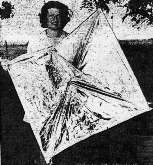
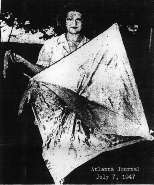
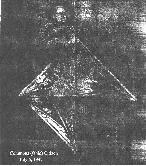
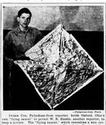
The first Circleville crash of around July 5 was very important since it was the first time that radar targets were used as a possible explanation for the flying saucers reported nationwide. Mention of this radar target crash received national coverage starting July 6, though photos seem to be primarily confined to the middle of the country, reaching down into Texas. (e.g., click here for July 7 front pages of the San Antonio Light and Fort Worth Star-Telegram ). The same day, one of Gen. Ramey's top officers at Fort Worth, Col. John D. Ryan, the base operations officer (also the next commanding officer at Roswell and a future USAF Chief of Staff/Chairman of the Joint Chiefs), was likewise talking about radar targets in connection with a story on theories about flying disc origins. Some suspect that the widely known Circleville story was the inspiration for Gen. Ramey's weather balloon debunking of the Roswell story on the afternoon of July 8 and for the military's nationwide debunking of the saucers as radar targets that immediately followed. The Circleville photos shown here come from the Columbus (Ohio) Sunday Dispatch, Columbus Citizen, Atlanta Journal (AP photo), and Valapraiso (IN) Vidette-Messenger (International Soundphoto--Added 2010). Outside of the Circleville area, the Journal and other papers like the Star-Telegram and Light carried the national AP wirephoto, while fewer carried the ISP wirephoto. Note surviving neck fragment of the balloon being held in the right hand. Click here for portions of local articles from the Columbus Dispatch, Columbus Citizen, and Circleville Herald. Another Circleville radar target recovery on July 8 was reported nationally by the A.P. on July 9 in their Roswell story. The Circleville Herald story on this incident is here. One interesting aspect of this story is that most of the balloon seemed to survive and was reported to be at least 10 feet in diameter when inflated. The likely source of the Circleville targets (and other recovered Ohio radar targets--see below) was the Army's Wilmington weather station, 60 miles west of Circleville and near Wright Field, which identified the radar target and is known to have been launching them at the time in large numbers as part of a thunderstorm research project [ref 2], Project Thunderstorm. Notice the comment from the Army weather officer in the Citizen article that, "Every weather station in the country uses them." Following the Roswell incident, the Wilmington weather station also staged a demonstration for the press on July 10 (click here).
Misc Ohio crashes reported
Because of the many radar targets being released in Ohio due to Project Thunderstorm, a number of other Ohio crashes were reported in the Roswell time frame after July 8, mostly by small-town press.
(Added 2026)
Dover Township, Ohio,~June 23 (~60 miles south of Cleveland). About 2 weeks before Circleville, farmer Leroy Leach found a radar target on his farm while plowing. It landed hard-driven by a heavy wind-storm, causing some of the sticks to break. He suspected it was part of a government experiment of some kind. He kept it as a curiosity until July 6 when a visiting cousin thought it a weather device, telling him the weather bureau might be interested in where it landed and he should report it. On July 8, he brought it to Marysville, OH, where it was identified and written up in the local newspaper July 10.
(Added 2026)
Frankfort, Ohio, June 30. (~30 mi E. of Wilmington, 10 mi. NW of Chillicothe, 20 mi. SW Circleville) A "four-sided" radar target was first found on a farm June 30 , but thinking it just a simple kite, the farmer set it aside until he heard about similar objects being recovered in the area. He then brought it to the Chillicothe Gazette July 11. Each side measured about 3 ft. 3 in. The large balloon was still attached. No photo. Short story in Chillicothe Gazette July 11.
(Added 2026)
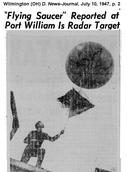
Port William, Ohio, July 9. (~30 mi SE of Dayton, OH & 10 mi. north of Wilmington, OH) The Power's family found a radar target at their home in the village of Port William, but apparently it had first been found on a farm and then placed at the home as a practical joke to convince Powers he had found a flying saucer. A reporter from Wilmington came with the head of the weather project there, L. M. Dye and quickly identified what was found based on descriptions, since Powers wasn't home. Instead the newspaper used the photo at right of one of the targets beings launched. Dye said it probably came from their project in Wilmington, Project Thunderstorm, and they had already sent up over 130 of the targets from 5 radar tracking stations and 150 radiosonde probes from 7 other stations. (article Wilmington paper July 10)
(Added 2026)
(~80 mi E. of Cincinnati, ~60 mi. SE of Wilmington) Barely reported by the Portsmouth (OH) Times, July 11 (~10 miles S. of Lucasville). Described as made of tinfoil and triangular in shape. Two other weather observation devices with parachutes were also found recently, these being raobs or radio transmitting weather balloons. The newspaper fancifully proposed these were dropped by Army planes during the night.
(Added 2026)
The Hillsboro Press-Gazette reported two other radar target crashes on July 15. (Hillsboro is ~40 miles east of Cincinnati, OH and 20 miles SE of Wilmington, OH.) The newspaper equated them to "flying saucers' and said they were being found across a 3-county area: Brown, Highland, and Clinton. One was found "recently" in nearby Lynchburg (~10 mi. N. of Hillsboro) by 2 brothers, who brought it to the newspaper. Another was recovered "the other day" by a sheriff near Boston OH (halfway between Cleveland and Akron) after residents there noticed something strange in a field and refused to go near it. The head of the Thunderstorm weather project, L. M. Dye, is again mentioned and provides more details about the project and targets. It was also stated that multiple radiosonde weather balloons with parachutes and radio transmitters were also being found.
(Added 2026)
The Cincinnati Post, August 21, reported another found near Forestville, a suburb of Cincinnati about 10 miles to the east. Found by a woman in a field, her son-in-law notified Army engineers, who came and picked it up. A Weather Bureau spokesman claimed it came from a weather station in Huntington, West Virginia, about 100 miles SE of Cincinnati, that regularly sent them up.
Oxford, Ohio, ~July 7. Recovery reported in the nearby Richmond Indiana Palladium-Item on July 9. The target was reported picked up on July 7, but had been noticed lying on the ground for several days before that. Click here for main story plus accompanying story by P-I reporter with military meteorological experience and familiar with radar targets. According to main story, others who viewed the object also had no problem identifying it as a radar target. The P-I reporter guessed that it came from a weather station in Illinois. More likely it came from the nearby Army thunderstorm project about 40 miles to the east.
Bakersfield, California, July 9. This target reportedly crashed on July 9. Photo is from the Bakersfield Californian, July 10. Notice this photo of the radar reflector is nearly indistinguishable from the ones at Circleville. The neck of the weather balloon is clearly visible in this photo near the bottom and appears already slightly darkened from exposure to sunlight. Click here for brief accompanying story. Source of the radar target is unknown, though possibly could have come from the radiosonde weather station at Santa Maria, CA (near to what is now Vandenberg AFB) 100 miles to the west, what is now Point Mugu Naval Air Station 80 miles to the south near Oxnard (and 40 mi. NW of Los Angeles), from Edwards AFB (then Muroc AAF) or George AFB 100 miles to the SE. Obviously some unknown weather or artillery unit was using the radar target within California.
Brawley, California, July 9. Near the Mexican border, the target reportedly crashed July 9, just as in Bakersfield. Unfortunately no photo, but the accompanying story from the Brawley News (also in the Imperial Valley News, El Centro, CA) suggests a similar if not identical radar reflector as that shown by Gen. Ramey. The story also states it was similar to the one supposedly found near Roswell The nearby El Centro Naval Air Station denied responsibility, and suggested Yuma, Arizona as a possible source (site of a Marine Corp air station and large army/air force bombing and gunnery ranges; the Army was also engaged in large-scale summer desert training at the time). Another possibility would have been the Naval weather station 100 miles west in San Diego. A rawin target demonstration in Kansas City stated rawins were indeed sent up from San Diego, but also from Westmorland, CA, which is less than 10 miles from Brawley. The News also reported a weather balloon recovery near Victorville, California, which seems to have been turned over to the neighboring air base (later George AFB). From the brief and ambiguous description, however, it wasn't clear if the weather balloon was of a radiosonde configuration or if it sported a radar reflector. The item spoke of both the "balloon and its kite" but also said that it had radio equipment. (Unfortunately, the weekly Victorville Sun newspaper had nothing about the incident, nor did the nearby San Bernardino Daily Sun.)
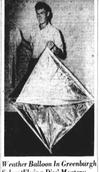
Greensburgh/White Plains, N.Y., July 10 Near New York City, the photo and stories come from the Yonkers N.Y. Herald Statesman, Port Arthur N.Y. Daily Item, and White Plains N.Y. Reporter-Dispatch, July 11. (Greensburgh and Port Arthur are about 5 miles apart.) The stories said the object had been found by 2 men the day before (July 10) in a graveyard. The source of the radar target was unknown. The articles and photo captions claimed the target solved the mystery of local flying saucer reports. The story went on that the civilians who found the object suspected it was a weather device right from the start. Note that the balloon, being held in the right hand, came down relatively intact. The New York City weather service was obviously familiar with the targets, and confirmed identification. And as stated many places elsewhere, the stories further says both the Army and civilian weather services utilized the radar reflectors. I have found the photo in 5 N.Y. newspapers, so this story got good regional coverage.
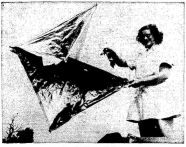
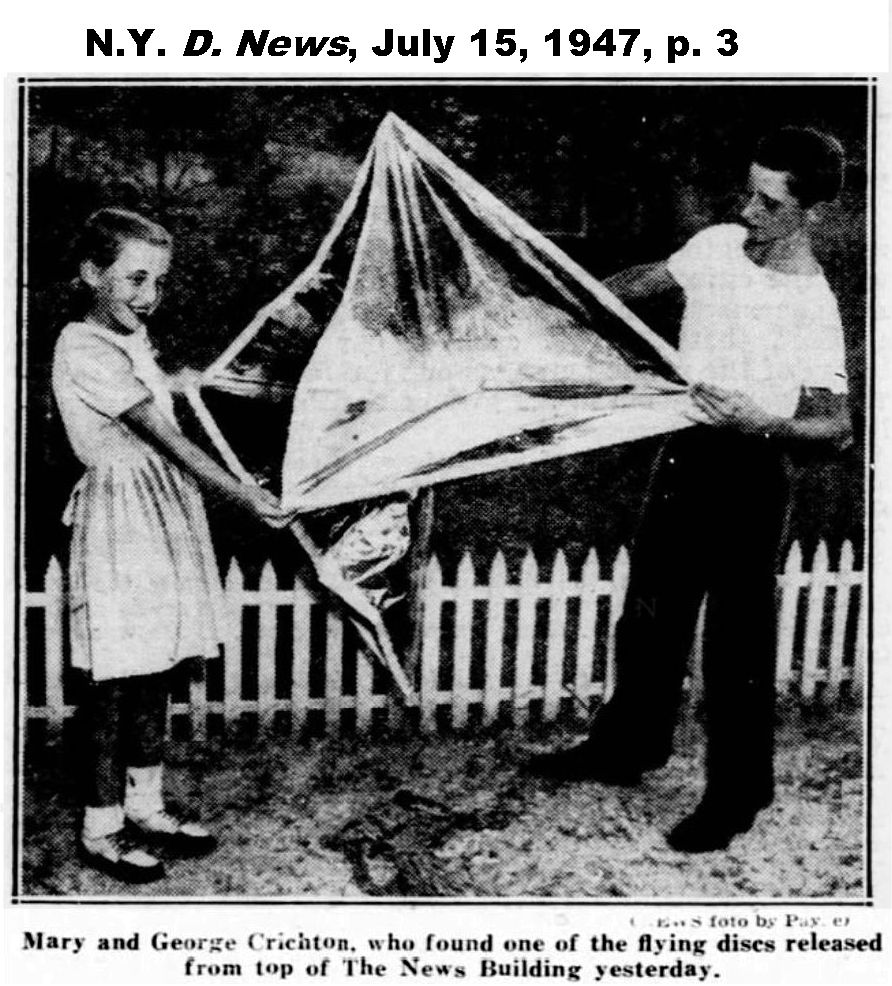
There is no mystery here as to the origins of this radar target. The N.Y. Daily News sent up 8 of them at noon July 14, to try to test the self-promoted theory of Brooklyn toy company president, Victor Hoeflich, that his radar targets, made for the military and weather services, caused all the flying saucer reports. Hoeflich had first approached them late evening of July 8, about the same time that Gen. Ramey was debunking Roswell as a radar target weather balloon. The News thought this made more sense than "Men-from-Mars" theories and decided to test it. (Hoeflich also staged his own demos on July 11 across from N.Y. City at a N.J. amusement park, launching at least 6 more targets.) The second of The News' launches came down 90 minutes later and 30 miles away at Lloyd Harbor and was immediately found by two children, shown in photo holding the target. Note, darkened remnants of balloon appears beneath target at their feet. The News also reported the weather bureau expert they used during their launches very accurately predicted where the target would likely come down based on known upper air currents and how long the lofting balloon would stay intact before popping at high altitude. Link is to page with all the NY Daily News articles and photos from July 9-15.
Tucson, Arizona, July 11. According to this somewhat sensationalized July 13 story in the The Arizona Daily Star (Tucson), two men nearly wrecked their truck on July 11 when a descending radar target almost landed on top of them. The article states that the object was like the one found near Roswell. Furthermore, one of the men claimed he was now sure he had seen these devices previously and that everyone else had been seeing the same thing. The story sounds suspiciously like a planted debunking article. Weathermen at the nearby Davis-Monthan airbase weather station denied using the devices, but stated that they were used by the Albuquerque and El Paso weather stations. In an earlier related story from the El Paso Herald-Post, the director of the U.S. weather bureau in El Paso said they did not use the radar targets, only radiosonde weather balloons, and claimed only the Army used the radar targets. He expressed great skepticism that anyone could mistake the slow-moving radar targets for the reported flying discs.
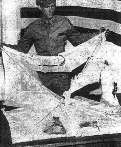
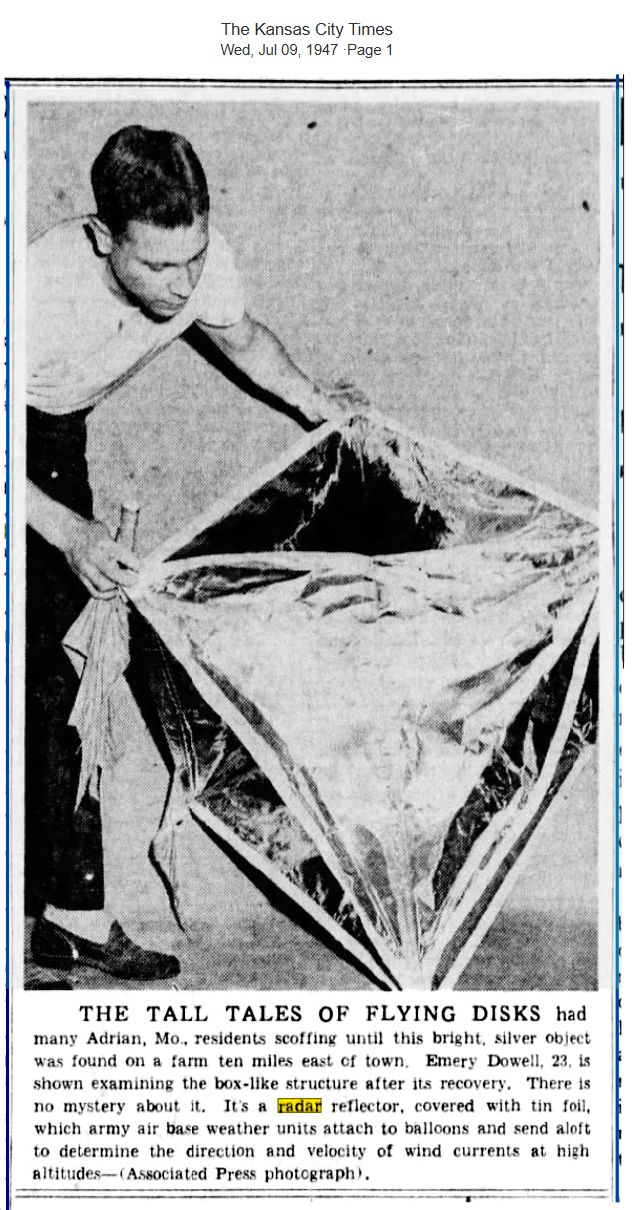
Adrian, Missouri, July 7. Nationally reported by the AP on July 9 in their Roswell story. It was stated that Grant Cook of Adrian found it on his farm and notified authorities. The Kansas City Weather Bureau reported that they had identified it. The likely source was the Fairfax Field Army weather station in Kansas City (see photo of radar target being launched there). The Kansas City Star-Times on July 9 carried a photo of the Adrian rawin target (see right), and stated in an accompanying story that it came from the Fairfax Field facility. Note in photo that most of the burst balloon in examiner's right hand is still attached to radar target. Click on links for photo and stories. (Added 2026)
Drexel, Missouri, July 10. Like some of the Ohio radar target crashes mentioned above, this and the next item are previously unknown target crashes I found in a search of newspapers.com. Drexel is only about 10 miles WNW of Adrian and 20 miles S of Kansas City. Found at 2 p.m. by farmer L.C. Dunnigton in a pasture 1-1/2 miles north of town. He immediately brought it to the newspaper. They reported it was a six-pointed star covered in tinfoil, had the markings "Feb. 21, WXX, MP" (almost exactly the same as reported for the Adrian object), and a burst balloon was still attached. It likely came from the same facility in Kansas City that caused the Adrian crash. No photo. Click here for short story from newspaper on July 10. So far, haven't found this incident mentioned in any other newspaper other than the small local paper, The Drexel Star. (Added 2026)
Carrollton, Missouri, July 5. Like Drexel, may have only been reported in the local small-town newspaper (the Carrollton Daily Democrat). The man who found it, Raymond Long, displayed it in the local square on Saturday, July 5. Long didn't think it a "flying saucer," but said it looked the same as the one pictured above in the Kansas City newspaper from Adrian, Missouri. It likely came from the same facility in Kansas City that caused the Adrian crash, or maybe Fort Leavenworth north of Kansas City, which also used them. No photo. Click here for short story from newspaper on July 9. (Added 2026)